

Reading time: ~4 min read
A complex system arises from a large number of smaller components that are all interrelated to one another. At the same time, this system is in a constant exchange and interface with surrounding structures. The parts comprising any complex system are constantly inter-reacting with one another, and it is not enough for a single component to be operating in order for the complete system to function. All of its components need to work together at the same time, in harmony, and in a flawless manner.
The eye is an example of one such complex structure, consisting of a large number of components, each of which is linked to others. Individually, the substructures of the eye cannot make vision possible. In order for the eye to see, all the components have to perform their own individual functions together, and flawlessly.
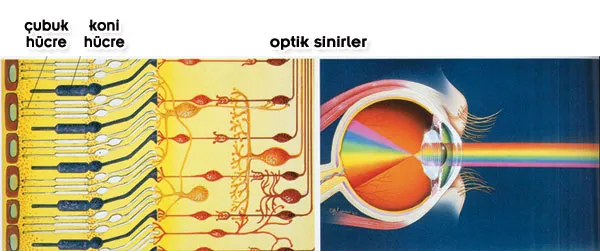
The complexity encapsulated within any single eye manifests itself similarly in a single cell of a living thing, or even at the fundamental level of a single protein within that cell. This interrelated sophistication is the greatest obstacle facing the Darwinist claim of “small, random changes” as an explanation for the development of species. As we know, random effects are almost always destructive. Any random mutation affecting a complex system will cause the collapse of that system, even if it affects only one of its components. Therefore, a mutation in the optic nerve will cause blindness in the eye. Excessive current—as in a power surge—will damage a radio. No one can imagine that it could turn that radio into a television. Therefore, any random effect impacting on the eye will inevitably damage it.
Recall that it is Allah Who creates the effects we refer to as random. Therefore, all the phenomena that take place are wholly planned, determined in the destiny set out by Allah. However, some people interpret these as occurring randomly. What they refer to as chance is not independent of Allah. For example, if one throws a handful of dry leaves into the air, each leaf will fall in a specific place. The phenomenon may be referred to as chance. But in fact the place where every leaf will fall is determined in the Sight of Allah. Any random mutation is described as accidental, but it is Allah Who creates both the mutation and its harmful effects.

As the result of random factors, complex systems are condemned to collapse. The Darwinist philosopher Daniel C. Dennett admits as such:
We consist of billions of cells, and a single human cell contains within itself complex “machinery”” that is still well beyond the artifactual powers of engineers.90
Therefore, biological complex systems can emerge only by being created by Allah, not through coincidental changes. The molecular biologist Michael Denton describes the situation by using an analogy:
In complex systems like a watch or a living system, all the subsystems are intensely integrated. Engineering changes in such systems is complex because each change to any one subsystem must be compatible with the functioning of all the other subsystems. Any change beyond a trivial degree is bound to necessitate intelligently directed compensatory changes in many of the interacting subsystems. In this context, it is hard to understand how undirected evolution via a series of independent changes could ever produce a radical redesign in any sort of system as complex as a living organism. It is precisely this integrated complexity which provides a major barrier to engineering radical change in living things from viruses to mammals.91
The principle that “all the subsystems comprising a complex system are intensely integrated” can also be seen in the early history of the animal kingdom.