

Reading time: ~6 min read
Large or small, just about every animal swimming in the sea, flying in the air or living on the land has been equipped with eyes. It comes as no surprise that a tiny fly or a crab has eyes letting it perceive its surroundings.
Yet the discovery of eyes on an arthropod 530 million years old is an extraordinary state of affairs that is difficult for evolutionists to believe. The eye, described by Darwin as an “organ of extreme perfection and complication"106, existed in an astonishing and complex form at a time when—according to him and his followers, there should have existed no complex life forms at all. The trilobite’s eye has shown scientists a great many perfect details that appeared during the Cambrian.
The trilobite eye’s most important distinguishing feature is calcite, one of the commonest minerals on Earth. Limestones consist largely of calcite and are the raw materials for buildings that stand for long periods of time. Calcite is the building block of pyramids, amphitheaters and historic columns that have survived the centuries down to the present day. The floors of Renaissance churches in Italy were made out of calcite. In short, stones rich in calcite were used throughout history for almost everything that needed to be attractive and hard-wearing.
The trilobite eye was composed of transparent calcite crystals—a feature that makes them unique in the entire animal kingdom.107
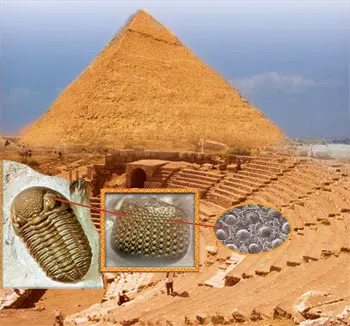
If you fracture a large piece of calcite crystal, you can see that it breaks along a regular plane, in line with its own atomic structure. What is left in your hand is a six-sided crystal, which allows light to pass through it. Calcite was specially created in order to perform this superior visual function in the trilobite.
The reason why the trilobite’s calcite structure makes its eye so unique is that other arthropods mostly have soft eyes. Since a trilobite’s calcite eyes have a structure similar to other hard parts of its body, they too have been well preserved. All the trilobite specimens obtained so far have provided comprehensive information about the eyes’ perfect and detailed structure.
The eyes were on top of the cheek of the animal and consisted of a large number of lenses.108Rather resembling a honeycomb, these lenses are just about as clear as a dragonfly’s. More interesting is the fact that they were fused together at the front of the animal.109
Trilobites’ eyes had another arthropod trait: their compound structure. These eyes contained numerous sub-units, each of which was a lens. Just like those in a fly’s compound eyes, each hexagonal unit served as an independent lens. Each one perceived a different image, which image was then combined into a whole. The only difference between a fly’s and a trilobite’s compound eyes is that the trilobite’s was made up of calcite, a mineral.110
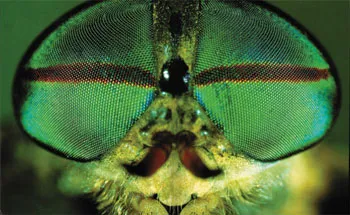
A trilobite eye is a miraculous construction of small, slender prisms. Each wide, hemispherical eye may have hundreds or even thousands of lenses, each of which perceived an image from a different direction. Some faced straight forwards, others to the side, and some even faced backward. Each lens focused on an area determined for it. The trilobite was thus able to perceive danger approaching from any direction, and also possessed a great advantage when hunting.
The average trilobite lens was long and thin, a few tens of thousandths of a millimeter across and hexagonal in shape. With their special geometry, the hexagons exhibited a perfect structure on the eye’s sloping convex surface. In order for that curve to be established and for a little space to be made around it, a few rare lenses had other shapes, and there were also variations in their arrangements.111It has been realized that the trilobite’s eye worked in the same way as those of present-day arthropods.
Since every lens “saw” a particular pre-selected field, the trilobite perceived the world as a mosaic of small images. The shape of any object before it must have varied slightly from lens to lens, with a different image produced by each one. The resolution of the images perceived also depended on the number of these lenses. More lenses of course meant better vision.
One of the most difficult jobs I ever attempted was to count the number of lenses in a large trilobite eye. I took several photographs of the eye from the different angles and then made enormous prints magnified large enough to see individual lenses. I started counting as one might, “One, two, three, four. . . ” and so on, to a hundred or two. The trouble was that you had only to look away for an instant, or sneeze, to forget exactly where you were, so it was back again to “One, two, three...”
...” ... I got to a total of more than three thousand before I vowed that, in future, I would simply estimate the number of lenses in a bit of an eye, and use my best arithmetic to estimate the whole number.112
More than 3,000 lenses means that the animal received more than 3,000 images. This clearly shows the degree of the complexity in the eye and brain structure of a creature that lived 530 million years ago. This flawless structure cannot have come into existence through evolution, as is set out by David Raup, a professor of geology from Harvard, Rochester and Chicago universities:
Thus the trilobites 450 million years ago used an optimal design which would require a well trained and imaginative optical engineer to develop today—or one who was familiar with the seventeenth-century optical literature.113