Reading time: ~1 min read
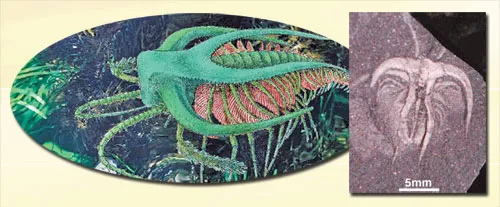
Marrella, described as a “lace crab” by Charles Walcott, is one of the most abundant of Burgess Shale fossils. Some 15,000 specimens of Marrella have been collected from Walcott Quarry (named after Walcott) alone. We have a three-dimensional knowledge of just about all this invertebrate’s features. Marrella’s head shield had two pairs of rearward spines that were sufficiently long to extend right along its body. It had two pairs of antennae. One of these was an extension consisting of short segments. The other had a brush-like end. Marrella’s body was composed of increasingly small trunk segments, each of which had a pair of legs. The antennae of this creature, which is thought to have fed on organic matter and small organisms, were probably used to gather up these small elements from the sea floor. The feathery filaments on the outer branch of its legs were used for respiration.72