

Reading time: ~3 min read
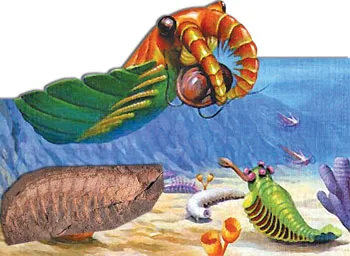
Among the most striking features of Cambrian species are the advanced organs they possess for attack and defense, in complex prey-predator relationships. That Cambrian life forms were equipped with such advanced weaponry, though there is no sign of such structures in the pre-Cambrian, demonstrates that this development of complexity was sudden and comprehensive.
The defense systems possessed by Cambrian creatures reveal that the Cambrian ecosystem was highly developed. Jun-Yuan Chen says that the Cambrian ecology, which emerged and grew very quickly, was just as developed as today’s:
Anomalocarid gibi canlılar, erken Kambriyen'de dahi çok gelişmiş, büyük, iyi uyum sağlamış avcılar bulunduğunun belirtisi. Bu da Kambriyen ekosistemlerinin günümüzde gördüklerinizden o kadar farklı olmadığını gösteriyor. Yaşam alanlarını farklı organizmalar dolduruyordu ama bunların yapılanması aynıydı.93
Nanjing Jeoloji ve Paleontoloji Enstitüsü'nden Jun-yuan Chen ise benzer bir değerlendirmesinde, hızla ortaya çıkıp büyüyen Kambriyen ekolojisinin günümüzdeki gibi gelişmiş olduğunu ifade etmiştir:
[In the Cambrian], there was a highly developed ecosystem. The food chain was as complicated as it is today.94
The predators that appeared suddenly in the Cambrian reveal an evident conflict with Darwinism’s concept of gradual development. Darwinism is based on the hypothesis of gradual development and countless intermediate forms in the fossil record and therefore, having incomplete, marginally functional structures. Similarly, it requires the remains of developing, but still half-formed complex attack and defense systems during the Cambrian Period. Yet these life forms were created suddenly, with completely functional and perfect structures for attack and defense.
The evolutionist writer Richard Monastersky describes the hollow nature of the hypothesis of gradual development:
People regarded the Cambrian as a rather early stage in the development of ecosystems. The assumption was that predation wouldn’t have been a very well developed strategy.According to this theory, the earliest predators would have started off as relatively simple creatures that then evolved more specialized features over many millions of years. As the predators added to their offensive weaponry, prey would evolve sophisticated defense systems.But the fossils show that the arms race accelerated almost overnight during the Cambrian explosion. Creatures with hard shells and long spines abound in the Chengjiang fauna, displaying a broad sweep of protective armor. Likewise, Anomalocaris appeared on the scene with an array of formidable feeding tools.95
The complexity that Cambrian fauna displays clearly and definitely repudiates the claims of the theory of evolution, because, in both fauna and on the species level, the theory demands considerable development from the simple to the more complex. Paleontologists who discover fauna that lived millions of years ago have to arrange them in terms of their relationships with one another and their environments, from the simple to the complex in order to demonstrate that any evolution occurred. However, Darwinism has been unable to provide any evidence for such evolution.
Species as complex as those of the Cambrian appeared not in the wake of simpler faunas extending in a vertical line up through geological strata, but in a unique and isolated manner. In the face of these facts, the only rational explanation that one can offer is that Allah created Cambrian fauna with all its complexity.