

Reading time: ~1 min read
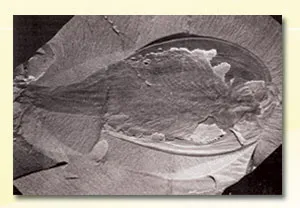
Branchiocaris had a hard shell consisting of two parts, covering the anterior part of its body. The trunk consisted of 40 divisions. The various appendages on its body were large structures resembling flaps. It had limbs. Its gut is also clearly visible in the fossil specimen.
Branchiocaris had appendages on its head. Short antennae were very strong and curved forward. Another pair of longer appendages was situated beside the antennae and ended in a claw. The trunk appendages are very evident in the specimens. The creature in all probability swam near the sea floor. It probably scavenged on dead or sessile organisms. The claws were used to carry food to the mouth. Its characteristics led to its being classified with arthropods.81
As you can see from these examples alone, Cambrian life forms were flawless creatures living in their own ecosystems and possessed features that were just as complex as those of organisms living today. Phacops, which lived in that period and is classified as a genus of trilobite—and which we shall be looking at in some detail in due course—had eyes with a very superior structure and are no different from those animals alive today.
These details concerning Cambrian life once again show that Darwinism is to be completely discounted. The various complex structures encountered in all kinds of invertebrate marine creatures appearing in this period are among the conundrums that evolutionists are unable to explain. The sudden emergence of vertebrates has made the situation confronting evolutionists even more difficult and problematic.