

Reading time: ~6 min read
Another disturbing aspect of fascism is that people living under such a regime are unable to develop their artistic talents, and that their scientific research fails to produce any productive results.
In order to determine the reason for this, we must first define what art is. Art is found in people taking pleasure in beauty and wanting to express it. Therefore, it first of all requires a soul capable of appreciating beauty. For instance, an artist who possesses feelings such as love and affection can see beauty in an animal, a landscape, or a plant. He experiences a feeling of joy, which he then tries to depict. A composer, in the presence of such beauty produces beautiful music, because his soul, feeling that beauty, longs to express it. The same applies to every other type of art, from literature to music.
However, it is impossible for those with a dark and cold soul, who are used to oppression and cruelty, and who have lost all semblance of humanity, to produce art. It is impossible for a person who believes in aggression and the superiority of force, who considers that bloodshed is necessary, who sees the world as a battleground, a kind of arena where only the strong have the right to live, to be affected by the beauties of nature or human beings, and influenced by their intricacies.
Those are the characteristics of fascists, and therefore, it is impossible for a fascist to possess any artistic feeling. The fascist soul is utterly debilitated and ignorant, and lacks all understanding, and considers art "unnecessary."
Actually, the fascists' hostility to art goes back to ancient Sparta, that ancient city which they took as a model. At a period when art was greatly prized in Athens, Sparta saw art as unnecessary, and raised its citizens instead to become warriors from an early age. It was virtually forbidden for Spartan children to take an interest in subjects such as reading and writing or art in their education.
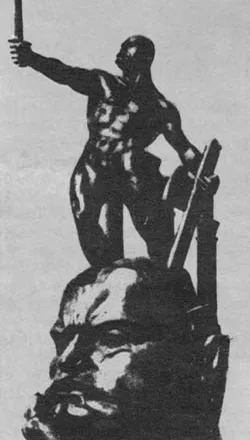
In 20th century fascist states, works of art, if any, were prepared and controlled by the state to serve as propaganda. These were the products of a soulless and mechanical "art to order." No real works of art emerged. For instance, only those subjects that the state allowed could be painted, such as war. Subjects disliked by the state were forbidden. The same applied to the written word, only those things the fascist state permitted could be written about, and nothing else. As a result, art totally unrelated to true art emerged, that, aesthetically, rendered art, architecture and literature rigid, soulless and dull.
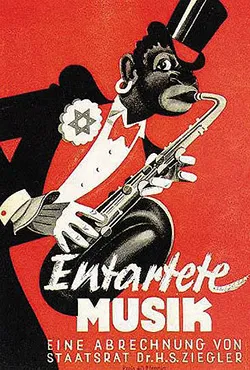
The most obvious examples of this were seen in Hitler's Germany. Because of his racist views, Hitler boycotted certain art forms. For example, because he looked on Africans as an "inferior race," the playing of jazz was forbidden in Germany, for it was regarded as "black man's music." In 1935, Eugen Hadamowski, the head of German radio, announced that by order of Hitler, he prohibited the playing of Negro jazz on German radio.
At the beginning of the 1940s, at the height of Hitler's power, jazz began to be used as a propaganda tool in radio broadcasts directed at Great Britain and America. At that time, and in most countries, jazz was one of the most popular forms of music. Europe's greatest jazz musicians were brought together. The first thing done was to translate all the English names of the famous jazz songs into German. The lyrics of these songs were altered to conform with Nazi propaganda, and was played only on programs aimed at the West, and completely forbidden on domestic German radio.
The lyrics of the songs were entirely fascist in content. Here is one example.
You're the greatest… You're a German pilot… You're machine gun fire… You're a heroic submariner… You're the greatest… You're a German bomber…54
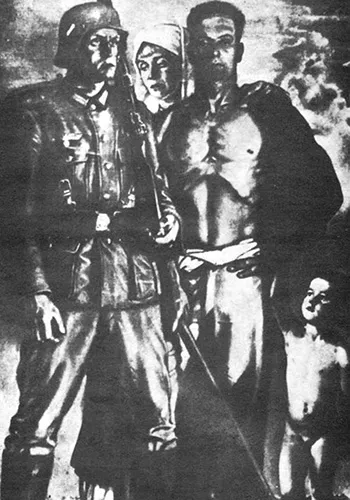
That was the Nazis' idea of art and music. Paintings, song lyrics, music and literature were all expected to include subjects approved of by the state. Painters could only paint subjects that encouraged the spirit of war. For instance, when the above-mentioned "state controlled jazz group" produced a record that did not consist of Nazi propaganda, they were immediately accused of being "degenerate" and warned never to try such a thing again.
And, that was not the end of Hitler's measures against artists. After the race laws of 1933, the Reichsmusikkammer (Reich Music Chamber) required a registry of all German musicians. As a result, hundreds of talented composers had their work deliberately suppressed and careers ended simply because their race or style of music offended the Third Reich. Famous works by Mendelssohn, Mahler and Schoenberg were used as examples of unacceptable music.55
According to Hitler, the role of art was to carry political messages in order to shape the mind of the public. What to Hitler was true art was that which portrayed life in the countryside, the healthy, and the Aryan race. In one speech, he offered his views on art and artists:
We shall discover and encourage the artists who are able to impress upon the State of the German people the cultural stamp of the Germanic race... in their origin and in the picture which they present they are the expressions of the soul and the ideals of the community.56
As can be discerned from all that has been mentioned, the artistic talents and scientific endeavor of people living under fascist regimes are ultimately fruitless. On the other hand, however, a society which lives by true religion sees great progress and development in the arts. Since religious people know that the universe and all living things in it were created by God, they look at everything around them with the intention of recognizing their beauty. They see the art in God's creation and are in awe of it. They see people, animals, plants and everything in nature as God's creations, and both love and appreciate them, realizing their beauty and detail. In fact, the greatest works of art in history arose out of inspiration artists have found in religious subjects.