

Reading time: ~3 min read
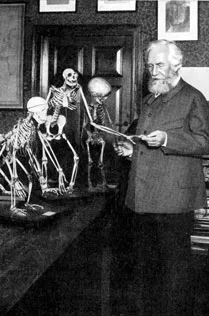
What used to be called the "recapitulation theory" has long been eliminated from scientific literature, but it is still being presented as a scientific reality by some evolutionist publications. The term "recapitulation" is a condensation of the dictum "Ontogeny recapitulates phylogeny", put forward by the evolutionist biologist Ernst Haeckel at the end of the 19th century.
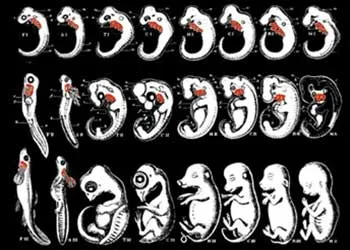
This theory of Haeckel's postulates that living embryos re-experience the evolutionary process that their pseudo-ancestors underwent. He theorised that during its development in its mother's womb, the human embryo first displayed the characteristics of a fish, and then those of a reptile, and finally those of a human.
It has since been proven that this theory is completely bogus. It is now known that the "gills" that supposedly appear in the early stages of the human embryo are in fact the initial phases of the middle-ear canal, parathyroid, and thymus. The part of the embryo that was likened to the "egg yolk pouch" turns out to be a pouch that produces blood for the infant. The part that had been identified as a "tail" by Haeckel and his followers is in fact the backbone, which resembles a tail only because it takes shape before the legs do.
These are universally acknowledged facts in the scientific world, and are accepted even by evolutionists themselves. George Gaylord Simpson, one of the founders of neo-Darwinism, writes:
Haeckel misstated the evolutionary principle involved. It is now firmly established that ontogeny does not repeat phylogeny.171
In an article published in American Scientist, we read:
Surely the biogenetic law is as dead as a doornail. It was finally exorcised from biology textbooks in the fifties. As a topic of serious theoretical inquiry it was extinct in the twenties…172
Another interesting aspect of "recapitulation" was Ernst Haeckel himself, a faker who falsified his drawings in order to support the theory he advanced. Haeckel's forgeries purported to show that fish and human embryos resembled one another. When he was caught out, the only defence he offered was that other evolutionists had committed similar offences:
After this compromising confession of "forgery" I should be obliged to consider myself condemned and annihilated if I had not the consolation of seeing side by side with me in the prisoners' dock hundreds of fellow culprits, among them many of the most trusted observers and most esteemed biologists. The great majority of all the diagrams in the best biological textbooks, treatises and journals would incur in the same degree the charge of "forgery", for all of them are inexact, and are more or less doctored, schematised and constructed.173
There are indeed "hundreds of fellow culprits, among them many of the most trusted observers and most esteemed biologists" whose studies are full of prejudiced conclusions, distortions, and even forgeries. This is because they have all conditioned themselves to champion evolutionary theory although there is not a shred of scientific evidence supporting it.