

Reading time: ~3 min read
These processes are carried out an average of 20,000 times a day in every one of the 100 trillion cells in the human body.97 Every enzyme knows where it must be and when, and at what stage it has to become involved. Every enzyme has its own place in the progression. Each adheres to the division of labor with immaculate co-ordination. There is not the slightest interruption, deficiency or delay in this system, or else DNA would be just a useless collection of molecules, leading to serious damage to the body.
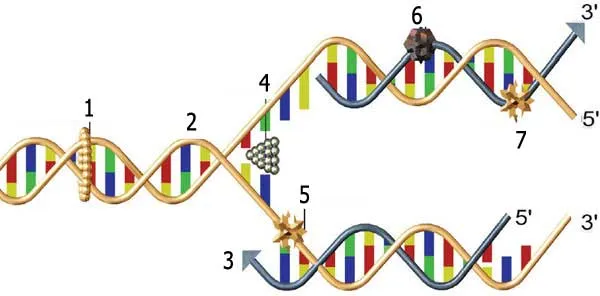
DNA enzymes are one example that entirely demolishes evolutionist claims of gradual and chance formation, because these enzymes are vitally necessary for DNA to be copied. Yet the information constituting these enzymes is also concealed inside the DNA. Therefore, the presence of DNA is essential for enzymes to come into being; and for enzymes, the prior existence of DNA is essential. The fact that two complex structures have to emerge at exactly the same time is a major difficulty for the theory of evolution, which cannot account for the emergence of either one of them.
This predicament is admitted by the evolutionist scientists Fred Hoyle and Chandra Wickramasinghe:
… Life cannot have had a random beginning. Troops of monkeys thundering away at random on typewriters could not produce the works of Shakespeare, for the practical reason that the whole observable universe is not large enough to contain the necessary monkey hordes, the necessary typewriters, and certainly the waste paper baskets required for the deposition of wrong attempts. The same is true for living material. The likelihood of the spontaneous formation of life from inanimate matter is one to a number with 40,000 noughts after it.. It is big enough to bury Darwin and the whole theory of evolution. There was no primeval soup, neither on this planet nor on any other, and if the beginnings of life were not random, they must therefore have been the product of purposeful intelligence.98
The enzymes that accomplish such difficult tasks are not possessed of consciousness and intelligence. Yet how do these unconscious accumulations of molecules perform actions that require conscious intelligence, such as making decisions, implementing those decisions, possessing foresight, preventing confusion, taking precautions within a flawless order, identifying and rectifying errors and carrying out repairs? The concept of chance, behind which evolutionists hide, loses all significance in the face of such a complex mechanism. Therefore, blind chance definitely constitutes no scientific answer to the question of the origin of life. Anyone of intelligence will agree that conscious, planned processes cannot be performed, one after the other, as the result of chance. The resistance of those who deny the existence of Allah in the face of all the facts is revealed in these terms in the Qur'an:
They said, "No matter what kind of Sign you bring us to bewitch us, we will not believe in you." (Surat al-A'raf, 132)
It is apparent that all the flawless elements in this system must have come into being in a single moment. This means that they have been created. These processes, which human beings find difficult to comprehend even as they read about them, are tasks performed, by Allah's choosing, with enormous ease and success by unconscious atoms at every single moment. In the Qur'an, Allah reveals:
He originates and regenerates. He is the Ever-Forgiving, the All-Loving, the Possessor of the Throne, the All-Glorious, the Doer of whatever He desires. (Surat al-Buruj, 13-16)