

Reading time: ~3 min read
DNA helicase, which opens up the DNA helix like a zipper
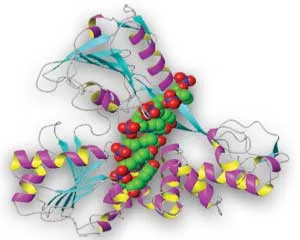
As you have seen, when the replication process begins, the enzyme known as DNA helicase is the first to arrive and begins opening up the DNA helix just like a zipper. As a result, the DNA's two entwined arms separate from one another. DNA helicase has the ability to open 1,000 nucleotide pairs a second.
As the DNA arms separate, helix stabilizing enzymes hold both arms to prevent them wrapping round each other once again.
As DNA helicase opens the zipper, it suddenly halts. The points where it stops set the two ends of the required information. Enzymes behave with enormous expertise, just as if they knew where the data began and ended.
DNA polymerase, the maker of new DNA strips
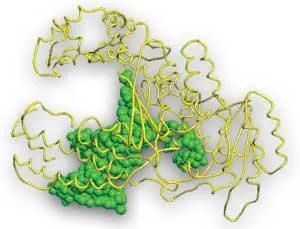
It is now the turn of DNA polymerase whose job, as you saw earlier, is to complete the divided arms of the DNA with a second arm of each. It therefore locates and fetches information corresponding to that one arm of the DNA.
DNA polymerase produces new strips in a complete and flawless manner. Cytosine in the old strip is always combined with guanine in the new one. Adenine is always joined up with thymine, and vice versa. However, during this matching process that takes place at such high speed, a few errors are bound to arise. Opposite adenine in one location, for example, the DNA polymerase may install guanine instead of thymine. Errors of this kind can sometimes represent a lethal danger. For instance, if the sixth amino acid in the structure of hemoglobin is replaced by another known as valine, thread-like fibers will emerge in the protein and prevent erythrocytes from moving about freely, leading to the disease known as sickle cell anemia.94
Just like an editor who corrects written texts, this enzyme identifies errors in the DNA and removes the wrong letter. However, this leaves a gap in the DNA helix. Another enzyme occupies itself with that problem.
DNA nuclease, exceedingly sensitive to errors
Just like an editor who corrects written texts, this enzyme identifies errors in the DNA and removes the wrong letter. However, this leaves a gap in the DNA helix. Another enzyme occupies itself with that problem.
DNA ligase, repairing breaks in the DNA
When the DNA nuclease identifies the mistaken section and extracts it, the resulting gap in the DNA strip is repaired by an enzyme known as DNA ligase. Thanks to the perfection obtained in this very final stage, only one error in a billion nucleotides is permitted - a level of error many times superior to any data system under computer control. One error in a billion is the equivalent of making only one mistake while copying thousands of books.95 This level shows what an extraordinary regulatory mechanism is compressed into a space too small to be seen with the naked eye.
Topoisomerase: enables DNA to be unraveled without knotting
DNA strips are packed into tiny volumes many thousands of times smaller than their length. In functioning in this small space, DNA may encounter several problems because of its shape. For example, as the DNA helix is opened up so that the information in it may be read, the some parts the bottom become increasingly compacted and that pressure needs to be released. This is just like pulling the fibers that make up a thread, one by one, which causes parts of the thread to become compacted. Immediately before the cell divides, an even larger problem may arise as the cell contains two copies of the DNA's 46 strips. Each one needs to be unraveled at once, and then separated and dispatched to the new cell.96.
The DNA enzymes known as topoisomerase overcome this major difficulty. One topoisomerase separates one strip of the DNA helix, thus causing the DNA to unravel and stretch out, thus relaxing the pressure from extreme compacting. This strip is subsequently recombined, reassuming its double helix form. By the mercy of Allah, all these systems carry out their functions to perfection, without us being aware of them, preserving the genetic information concealed in the DNA strips.