

Reading time: ~6 min read
Throughout the day, without your ever being aware of it, your cells carry out countless processes with an extraordinary care and sense of responsibility, for you to continue living in a healthy state. One of these processes is cell division, which permits growth and tissue repair. DNA's ability to be copied enables damaged tissue to repair itself by means of cells dividing and multiplying, during the course of which the original genetic information is transmitted to every new cell.
Most of the cells in the human body divide and multiply. During the course of cell division, the replication of the DNA in the cell nucleus is carried out in such an astonishingly organized and disciplined way. Even when the human embryo is no more than a single cell, it divides into two, and progressively, from two to four, to eight . . . and an exact copy of the original DNA needs to be produced for the new cell. In fact, shortly before a cell divides, DNA replicates itself and transmitsit to the new cell.
According to observations of the process, the cell has to reach a specific size before dividing. The moment this particular size is exceeded, the process of division begins in a programmed manner. The shape of the cell begins flattening out, and the DNA replicates itself.
The cell as a whole decides to divide, and the different components within it begin behaving in appropriately. Clear, however, cells by themselves are incapable of managing such a collective task. The process of division begins at Allah's command, and all the components of the cell, especially DNA, act accordingly.
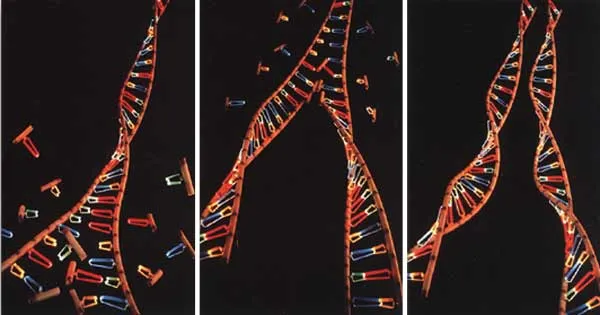
The DNA molecule, with its data-bank of 3 billion letters, resembles a double spiral staircase. When the replication process begins, first an enzyme known as DNA helicase arrives and begins opening up the DNA helix, just like a zipper. As a result, the two strips of the helix, formerly wound around one another, separate. DNA helicase is always on duty at exactly the right time and performs its work flawlessly, never making a mistake that would cause any harm to the DNA.
Once the DNA molecule has assumed the form of two lengthy strips, the work is now handed over to the enzyme DNA polymerase, whose job is to make provide each separated arm of the DNA with a new strip. To do this, it finds and brings in the appropriate data comprising each of the DNA strips. An enzyme made up of atoms, devoid of any consciousness or intelligence, identifies the information needed to complete the two DNA halves, and installs them accordingly. During the course of all of this, it makes not the slightest error, but completes and identifies all the 3 billion letters concerned one by one, with perfect accuracy. At this point, another polymerase enzyme completes the other half of the DNA in exactly the same way. As all this takes place, helix stabilizing enzymes hold on to the ends of the DNA to prevent the two separate strips from winding around one another again.
In this way, the two missing halves of the DNA strip are completed, using materials already found in the surrounding cell, and two new DNA molecules are produced. Expert proteins known as enzymes, working just like highly advanced robots, act in every phase of the operation. During these stages, a great many highly complex intermediate processes occur, which would also provide the subject for a book.
The new DNA molecules that are copied are checked many times by supervising enzymes. Any error –and such errors could have lethal consequences– is immediately identified and corrected. The flawed code is extracted and the correct gene brought in and assembled.
James Watson and Francis Crick, the scientists who discovered the structure of DNA, reduced the replication process they described as a "perfect biological principle," to a very simple form. Today, however, we know that the way DNA copies itself is so complex as to amaze scientists. Twenty separate proteins and enzymes must be present for even the smallest strip of DNA to be replicated.88 Prof. Werner Gitt describes the perfection inherent in this replication:
The DNA is structured in such a way that it can be replicated every time a cell divides in two. Each of the two daughter cells must have identically same genetic information after the division and copying process. This replication is so precise . . . .89
One of the most miraculous aspects of DNA replication is that unconscious is molecules carry out everything described here. Enzymes consisting of combinations of unconscious atoms identify the missing sections of the DNA helix, obtain the missing parts and install them in the right locations. No doubt, the way such minuscule structures with no consciousness or intelligence flawlessly perform processes requiring all these features exhibits the incomparable nature of Allah's creation. All these elements behave at Allah's command. With the ability bestowed on them by Him, they perform such a vitally important process for human life in the most immaculate way. The organization in Allah's creation is revealed in these terms in the Qur'an:
Does man reckon he will be left to go on unchecked? Was he not a drop of ejaculated sperm, then a blood-clot which He created and shaped,making from it both sexes, male and female? (Surah al-Qiyama, 36-39)