

Reading time: ~13 min read
The theory of evolution maintains that human beings and present-day apes share an imaginary common ancestor. According to evolutionists, these imaginary primitive creatures gradually evolved, with one branch coming to form present-day apes, and the other group present-day human beings.
Evolutionists point to Australopithecus, whose Latin name means "South African ape," as the first supposed common ancestor between humans and apes. The various types of Australopithecus were in fact nothing more than an extinct species of ape. Some of these were very large and others much smaller, while other had more delicate features.
Evolutionists attach the prefix Homo, meaning "man," to the next stage, or genus, of imaginary human evolution. They claim that creatures in the Homo sequence were more advanced than Australopithecus and not all that different from present-day humans. The final stage of this supposed evolutionary process is Homo sapiens sapiens, today’s man. Of course, this complete story is a fairly comprehensive deceit.
The facts, however, are that Australopithecus is an extinct species of ape, while those in the Neanderthal and early Homo series are races of human beings who once lived but have since become extinct. Evolutionists have set out various ape and human fossils in order of size to produce a chronology of human evolution. Yet scientific facts prove that these fossils do not prove any evolutionary process: Some of these entities depicted as the forerunners of present-day humans were genuine apes, while others were genuine humans.
However, since evolutionists had made such a daring claim, they needed to prove it, at least in their own minds, and so attempt to present so-called evidence by resorting to various frauds.
In their search for evidence to substantiate the theory of evolution, they most frequently resort to the fossil record. But when examined carefully and objectively, the fossil record does not support the theory of evolution at all, but totally undermines it. Yet because evolutionists generally offer biased evaluations of fossils and pass them on to the public, many people imagine that the fossil record actually corroborates the theory of evolution. Yet even though 99% of the fossil record has been unearthed and catalogued, evolutionists still do not have a single piece of evidence to support their claims. For that reason, some evolutionists have attempted to manufacture their own fossils as alleged evidence for their theories, though subsequently these "remains" have been exposed as either hoaxes or distorted misinterpretations. Fossils in the Earth’s strata today confirm that living things have existed in perfect form ever since they were first created. Evolutionists construct their imaginary reconstructions (models or drawings) on the basis of fossil remains in such a way as to corroborate the claims of evolution. Since people are most easily influenced by visual materials, their aim is to use imagination to convince people that such creatures actually once existed. The fact is that nothing like those creatures in these pictures ever existed.
Evolutionist researchers generally produce their reconstructions of imaginary, human-like beings on the basis of a single tooth, fragment of jawbone, or a tiny arm bone and then sensationally declare these to be links in the story of human evolution. Such drawings have played a considerable role in forming the public's image of imaginary "primitive man". The fact is, however, that no such primitive man ever lived. The pictures in question are intended solely as speculation. All the fossils discovered belong to perfect life forms.
The claim of human evolution is even regarded as groundless by the people involved in shaping it. The claim is based, not on science, but on the beliefs and prejudices that shape the theory. But the interesting thing is how these “admissions” from the world of paleoanthropology are never reflected in the press. On the contrary, one part of the media that supports Darwinism is careful to conceal this predicament facing the theory of evolution and deceives the public by telling them that “new evidence for evolution is being discovered every day.”
A great many evolutionists, beginning with Charles Darwin himself, have generally had to admit that the commonest subject for speculation are the claims regarding fictitious primitive man.
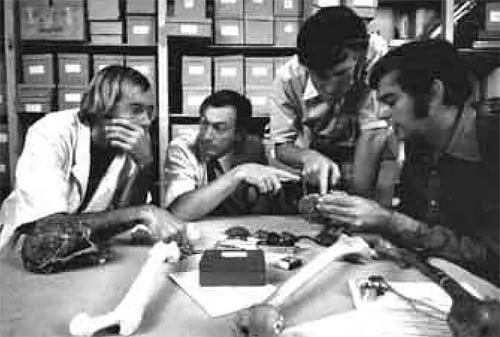
Charles Darwin:
You ask whether I shall discuss "man";-I think I shall avoid whole subject... My work, on which I have now been at work more or less for 20 years, will not fix or settle anything...272
... but I was dreadfully disappointed about [the evolution of] Man.273
Richard Leakey - Roger Lewin (after a lengthy exposition of hypotheses regarding human evolution):
Isolated teeth, single bones, fragments of skulls: for the most part, these are the clues from which the story of human prehistory must be reconstructed.274
Dr. Robert Martin is senior research fellow at the Zoological Society of London:
In recent years several authors have written popular books on human origins which were based more on fantasy and subjectivity than on fact and objectivity. At the moment science cannot offer a full answer on the origin of humanity, but scientific method takes us closer to the truth...275
Richard Leakey, a well-known evolutionist:
David Pilbeam [a well-known expert in human evolution] comments wryly, “If you brought in a smart scientist from another discipline and showed him the meager evidence we've got, he'd surely say, 'Forget it: there isn't enough to go on.”276
Richard Leakey and Roger Lewin:
Many discoveries of supposed hominids consist of only a mouth fragment, a leg bone, a hip bone, or a knee joint.277
If someone went to the trouble of collecting into one room all the fossil remains so far discovered of our ancestors (and their biological relatives) who lived, say, between five and one million years ago, he would need only a couple of large trestle tables on which to spread them out. And if that were not bad enough, a not unusually commodious shoe box would be more than sufficient to accommodate the hominid fossil finds of between fifteen and six million years ago.278
The human mind has shown itself to be particularly fertile for generating notions about the nature of mankind, but only when those notions are subject to the scrutiny of different scientific disciplines can the more fanciful theories be weeded out. In learning about hominid history we have to be imaginative, but not fanciful, the inputs and caveats offered by the psychologists, taphonomists, and others create the right condition in which to be responsibly imaginative.279
F. Clark Howell, professor and chairman of the Anthropology Department at the University of Chicago, discusses Piltdown Man, one of the most notorious forgeries in history:
Piltdown was discovered in 1953 to have been nothing more than an ape's jaw placed with a human skull. It was a hoax placed on purpose. They recognized neither the jaw to be an ape's or the skull to be a human's. Instead, they declared each part as [from] an in-between [species] of ape and human. They dated it to be 500,000 years old, gave it a name (Eoanthropus Dawsoni or "Dawson's Dawn Man"), and wrote some 500 books on it. The "discovery" fooled paleontologists for forty-five years.280
Wray Herbert is psychology editor for Science News, editor-in-chief of Psychology Today, and science and medicine editor at US News & World Report:
According to John Hopkins University anthropologist Alan Walker, there is a long tradition of misinterpreting various bones as human clavicles; in the past, he says, skilled anthropologists have erroneously described an alligator femur and the toe of a three-toed horse as clavicles.281
Boyce Rensberger is author of popular science books and director of the Knight Science Journalism Fellowships program at the Massachusetts Institute of Technology:
In 1984, a 12-year old boy of the Homo erectus species, dated at 1.6 million years old, was dug up in Kenya. His body skeleton was virtually indistinguishable from our own.282
Jerald M. Loewenstein and Adrienne L. Zihlman in New Scientist, dated December 1988:
... anatomy and the fossil record cannot be relied upon for evolutionary lineages. Yet palaeontologists persist in doing just this.... The subjective element in this approach to building evolutionary trees, which many palaeontologists advocate with almost religious fervour, is demonstrated by the outcome: there is no single family tree on which they agree. On the contrary, almost every conceivable combination and permutation of living and extinct hominoids has been proposed by one cladist or another.283
David Pilbeam is professor of social sciences at Harvard University and curator of paleontology at the Peabody Museum:
My reservations concern not so much this book [Richard Leakey's Origins], but the whole subject and methodology of paleoanthropology... Perhaps generations of students of human evolution, including myself, have been flailing about in the dark; ... our data base is too sparse, too slippery, for it to be able to mold our theories.284
Theory shapes the way we think about, even perceive, data... We are unaware of many of our assumptions.285
In the course of rethinking my ideas about human evolution, I have changed somewhat as a scientist. I am aware of the prevalence of implicit assumptions and try harder to dig them out of my own thinking...286
At least in paleoanthropology, data are still so sparse that theory heavily influences interpretations. Theories have, in the past, clearly reflected our current ideologies instead of the actual data.287
Roger Lewin is a well-known evolutionist writer:
In the physical realm, any theory of human evolution must explain how it was that an ape-like ancestor, equipped with powerful jaws and long, dagger-like canine teeth and able to run at speed on four limbs, became transformed into a slow, bipedal animal whose natural means of defense were at best puny. Add to this the powers of intellect, speech and morality, upon which we "stand raised as upon a mountain top," as Huxley put it; and one has the complete challenge to evolutionary theory.288
Robert B. Eckhardt is professor of anthropology at Penn State University:
Amid the bewildering array of early fossil hominids, is there one whose morphology marks it as man's hominid ancestor? If the factor of genetic variability is considered, the answer appears to be no.289
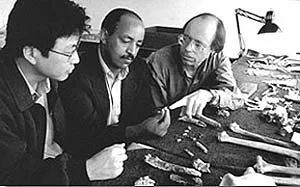
Dr. Tim White is an evolution anthropologist at the University of California in Berkeley:
Perhaps no area of science is more contentious than the search for human origins. Elite paleontologists disagree over even the most basic outlines of the human family tree. [So-called] New branches grow amid great fanfare, only to wither and die in the face of new fossil finds.290
Lyall Watson has degrees in botany and zoology and is also doctor of philosophy degree in ethology under Desmond Morris at London Zoo:
Modern apes, for instance, seem to have sprung out of nowhere. They have no yesterday, no fossil record. And the true origin of modern humans-of upright, naked, tool-making, big-brained beings-is, to be honest with ourselves, an equally mysterious matter.291
William R. Fix is the author of the book, The Bone Peddlers:
As we have seen, there are numerous scientists and popularizers today who have the temerity to tell us that there is "no doubt" how man originated. If only they had the evidence...292
Dr. Tim White:
A five million-year-old piece of bone that was thought to be a collarbone of a human-like creature is actually part of a dolphin rib according to an anthropologist at the University of California, Berkeley... The problem with a lot of anthropologists is that they want so much to find a hominid that any scrap of bone becomes a hominid bone.293
In 1994, the American anthropologist Holly Smith conducted detailed analyses indicating that Homo habilis was not Homo-in other words, not human at all-but rather unequivocally an ape. Speaking of the analyses she made on the teeth of Australopithecus, Homo habilis, H. erectus and H. neanderthalensis, Smith stated:
Restricting analysis of fossils to specimens satisfying these criteria, patterns of dental development of gracile australopithecines and Homo habilis remain classified with African apes. Those of Homo erectus and Neanderthals are classified with humans.294
Stephen J. Gould:
What has become of our ladder if there are three coexisting lineages of hominids (A. africanus, the robust australopithecines, and H. habilis), none clearly derived from another? Moreover, none of the three display any evolutionary trends during their tenure on Earth.295
Evolutionist paleontologists Claude A. Villee is professor of biological chemistry at Harvard Medical School, Eldra P. Solomon is licensed psychologist at Center for Mental Health Education, Tampa, Florida, and Percival William Davis is a professor of life science at Hillsborough Community College:
We [humans] appear suddenly in the fossil record...296
Niles Eldredge and Ian Tattersall are paleontologists on the curatorial staff of the American Museum of Natural History.
It is a myth that the evolutionary histories of living things are essentially a matter of discovery. If this were true, one could confidently expect that as more hominid fossils were found, the story of human evolution would become clearer. Whereas if anything, the opposite has occurred.297
Henry Gee editor in Nature magazine:
... the chain of ancestry and descent... [is] a completely human invention created after the fact, shaped to accord with human prejudices.... To take a line of fossils and claim that they represent a lineage is not a scientific hypothesis that can be tested, but an assertion that carries the same validity as a bedtime story-amusing, perhaps even instructive, but not scientific.298
John Durant is a historian at Oxford University; from a meeting at the British Association for the Advancement of Science:
Could it be that, like "primitive" myths, theories of human evolution reinforce the value-systems of their creators by reflecting historically their image of themselves and of the society which they live?299
... Time and again, ideas about human origins turn out on closer examination to tell us as much about the present as about the past, as much about our own experiences as about those of our remote ancestors.... [W]e are in urgent need of the de-mythologisation of science.300
Darwinists use the following ancient method with regard to the fictitious evolution of man: they take fossils from an extinct gorilla or chimpanzee; that is an easy matter for Darwinists, because ONLY 200 OF THE 6000 MONKEY SPECIES THAT HAVE EVER EXISTED ARE STILL ALIVE TODAY. In other words, fossils from the remaining 5880 species are a perfect speculative tool for Darwinists.
In using these fossils, Darwinists generally come up with such illogical and utterly primitive scenarios as “all right, this is a monkey, but it has a curved thumb and so, it must be turning into a human being.” That idea is utterly illogical, but when these illogical accounts are published in world-renowned Darwinist magazines, when scientific language and terminology that mobody can understand are used and when the people saying these things are are professors who blindly defend Darwinism, in other words, when a lie is repeated over and over again, then the idea may seem quite convincing to people wihout much knowledge of the subject. Darwinists have been engaging in this unpleasant rrickery for years, taking advantage of people’s ignorance, the empact of the media and various propaganda techniques.
There are numerous instances of this.