

Reading time: ~4 min read
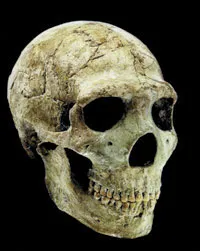
Neanderthals appeared suddenly in Europe around 100,000 years ago, disappearing again-or else assimilating with other human races-just as rapidly and silently 35,000 years ago. The only difference between these and present-day humans is that their skeletons were rather more powerful and their skulls, on average, slightly larger.
Neanderthals were a human race, and this is generally agreed upon by all. Evolutionists long attempted to portray these people as a primitive species, but all the findings showed that the Neanderthals were no different to any well-built individual walking down the street today.
For that reason, many contemporary researchers refer to Neanderthal Man as a present-day human race. Findings show that the Neanderthals buried their dead, used a variety of musical instruments and shared an advanced culture with Homo sapiens sapiens ("human" according to the imaginary classifications of Darwinists), living at the same time. In short, the Neanderthals were simply a large-bodied race of humans that gradually disappeared.
A great many evolutionist scientists, beginning with Charles Darwin himself, have had to recognize and admit this reality.
Charles Darwin:
Nevertheless, it must be admitted that some skulls of very high antiquity, such as the famous one of Neanderthal, are well developed and capacious.317
C. Loring Brace, an evolutionist anthropologist:
Neanderthals had short, narrow skulls, large cheekbones and noses and, most distinctive, bunlike bony bumps on the backs of their heads. Many modern Danes and Norwegians have identical features, Brace reported at the annual meeting of the American Anthropological Association in Phoenix... Indeed, the present-day European skulls resemble Neanderthal skulls more closely than they resemble the skulls of American Indians or Australian aborigines.318
Erik Trinkaus is professor of physical anthropology at Washington University in St. Louis:
Detailed comparisons of Neanderthal skeletal remains with those of modern humans have shown that there is nothing in Neanderthal anatomy that conclusively indicates locomotor, manipulative, intellectual, or linguistic abilities inferior to those of modern humans.319
From Prevention magazine, a pro-evolution periodical:
Dr. Francis Ivanhoe (London) solved the Neanderthal puzzle by having his research published in Nature magazine in August, 1970. Dr. Francis Ivanhoe has claimed that the teeth of Neanderthal Man show specific evidence of rickets (caused by a Vitamin D deficiency) and that X-rays of the bones of Neanderthal Man show the characteristic rickets ring pattern.320
He had a brain with a capacity sometimes larger than that of modern man. He was a talented toolmaker and successful hunter, even dabbled in art and, most importantly from a cultural standpoint, developed a rudimentary social and religious consciousness.321
Bonnie Blackwell is an evolutionist geologist at the City University of New York's Queens College:
Neanderthals were apparently quite similar to Homo sapiens in their behavior and cognitive capacities. In both groups, musical traditions probably extend back very far into prehistory. The Slovenian bone closely resembles several hole-bearing bones that were likely to have been used as musical instruments by humans at later European sites, according to archaeologist Randall K. White of New York University.322
Sarah Bunney is an executive editor and science writer:
Paleontologists in Israel have discovered a fossil bone which shows that Neanderthals may have been just as capable of speech as modern humans. The bone, known as the hyoid, is from a Neanderthal who lived between 50,000 and 60,000 years ago. The hyoid, a small U-shaped bone, is a key part of the vocal apparatus in modern human beings. According to B. Arensberg and Yoel Rak of Tel Aviv University and their colleagues, the fossil hyoid, in size and shape, is just like a modern human's... The researchers believe that, despite their heavy jawbones, Neanderthals spoke a language.323
The Neanderthals were a human race, with large, powerful muscles, who managed to survive in a harsh environment. Their tools remained the same for thousands upon thousands of years. There is no indication of evolution in their technology or behaviour.324
Milford Wolpoff is professor of anthropology at the University of Michigan:
Others helped a Neanderthal survive. Did they love him, did he make a valuable contribution to his community, were these his children and did they protect only their own relatives? Yes, we can invent all kinds of stories as to why this happened. The important thing is that these all belong to human beings. There are no animal fables and this behavior of theirs points to a social depth. They knew everything, and the Neanderthals lacked nothing of modern man's behavioral capacity...325