

Reading time: ~2 min read
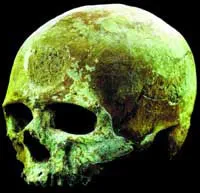
Cro-magnon fossils were first discovered in March 1868 in a cave in Les Eyzies in France. There is no major anatomical difference between these individuals and present-day humans, yet evolutionists try to use biased interpretations to portray Cro-Magnon Man as different from today’s human beings. In fact, Cro-Magnons were a human race now estimated to have lived around 30,000 years ago.
The skull structure of people living in Europe today does not resemble that of Cro-Magnons. Their skull structure and volume do, however, resemble that of some races currently living in Africa and tropical climes. On the basis of that resemblance, we can say that Cro-Magnons were an ancient race originating from Africa.
Cro-Magons disappeared very quickly. There is only one reason for that; paleoanthropological discoveries have shown that the Cro-Magnon and Neanderthal races combined with one another to form the basis of today's races.
Randall White is Professor of Anthropology at New York University:
Cro-Magnon artifacts have a right to stand alongside those of the entire history of mankind. From a 20th century perspective the extraordinary thing about the existence of Cro-Magnons is that they underwent no direct, gradual evolution from the crude and unformed to selectivity and perfection. The history of art begins 35,000 years ago.326
James Shreeve is a science journalist in magazines like Science, National Geographic and Smithsonian:
New dating methods have revealed that fossils thought to be 40,000 years old are actually 100,000 years old. Now, if Cro-Magnons are older than the Neanderthals who lived 60,000 years ago, how can they be descended from them?
Dorothy Great from Britain discovered both Neanderthal and Cro-Magnon remains in the Stark Hills behind Tel Aviv. Assumed that they were compatible with the previously estimated chronology, the Neanderthals were concluded to be around 60,000 years old, and the Cro-Magnons around 40,000. Some researchers were unconvinced. They believed that the stratification in the caves had been damaged by water currents and determined a new date using another dating method.
Eventually it was concluded that present-day humans appeared in the land of Israel before the Neanderthals. The new dating provoked considerable surprise, because it stated that modern-looking fossils were actually 100,000 years old. The Neanderthals, on the other hand, were 60,000 years old. On the basis of this evidence, Cro-Magnons cannot have evolved from the Neanderthals.
There are many scenarios concerning the extinction of species... These are full of assumptions. There is no evidence of any wars or violent conflict in these valleys. All there is, is a strange disappearance, and isolated fossils.327