Reading time: ~3 min read
We have already examined the roots of Nazi ideology and its attitude to religion. As is shown in the examples we have considered, the Nazi ideology was perverse and opposed to all divine religions. The foundations of this ideology rest on Nietzsche's anti-religious philosophy, and Darwin's atheist theory of evolution which denies the fact of creation. The Nazis' perspective of ethics was in imitation of the pagan culture of ancient Greece and pre-Christian barbarian German tribes: Nazism was a pagan, idolatrous ideology.
This fact has been expressed by many commentators on the subject. In an article titled "Darwinism and the Nazi Race Holocaust," the American researcher Jerry Bergman describes the Nazis' view of religion as such,
Expunging of the Judeo-Christian doctrine of the divine origin of humans from mainline German (liberal) theology and its schools, and replacing it with Darwinism, openly contributed to the acceptance of Social Darwinism that culminated in the tragedy of the holocaust.102
Daniel Gasman, the author of The Scientific Origins of National Socialism, agrees:
[Hitler] stressed and singled out the idea of biological evolution as the most forceful weapon against traditional religion and he repeatedly condemned Christianity for its opposition to the teachings of evolution. For Hitler evolution was the hallmark of modern science and culture, and he defended its veracity as tenaciously as Haeckel.103

Hitler once revealed his hatred of religion when he bluntly stated that religion is an:
…organized lie [that] must be smashed. The State must remain the absolute master. When I was younger, I thought it was necessary to set about [destroying religion] …with dynamite. I've since realized there's room for a little subtlety... The final state must be… in St. Peter's Chair, a senile officiant; facing him a few sinister old women… The young and healthy are on our side… Our peoples had previously succeeded in living all right without this religion. I have six divisions of SS men absolutely indifferent in matters of religion. It doesn't prevent them from going to their death with serenity in their souls.104
As we have seen, the only notion Hitler considered necessary, on a spiritual level, was the understanding which leads people to "go to their death with serenity in their souls." This ideal was found in such pagan concepts as "the German soul," and "martial honor." He looked on divine religions, on the other hand, as beliefs that need to be "destroyed with dynamite."
Hitler summed up his views on religion to his staff at a meeting at his house in Oberzalsberg:
You see it's been our misfortune to have the wrong religion. Why didn't we have the religion of the Japanese, who regard sacrifice for the Fatherland as the highest good?105
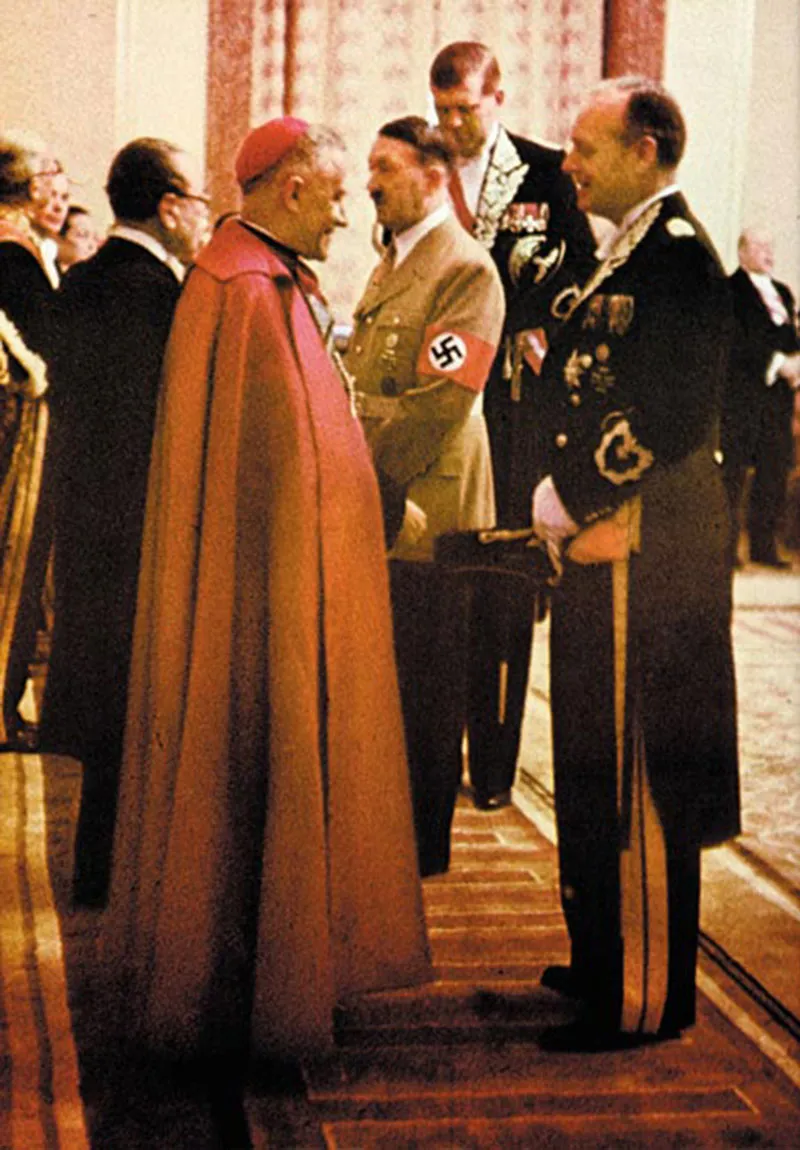
This was Hitler's true opinion of religion. If religion had commanded war, as with that of the Japanese, then it could be accepted in order to be used for his own ends. But Christianity taught peace, not war, and personal sacrifice instead of selfishness and rivalry. For this reason, the Nazi Party waged a continuous war against the Catholic Church.
But it also tried to establish a "Christianity appropriate to Nazism."