

Reading time: ~5 min read
Mussolini underwent a sudden personal change at the end of the 1910s. After having been a radical communist for so long, he then emerged as the leader of the ideology known as "fascism" as it set out on its way to power. This movement took the "axe" of ancient Roman paganism as its symbol. However, Mussolini did not himself discover "fascism," but rather developed it from the racist trends which had been escalating in Italy during that period. But, even though he did not invent the ideology, he soon made it his own and turned it into a political movement. Just like Hitler, he gathered ignorant people around him, street thugs, adventurers, and instigators of violence. He grouped them together in a quasi-military organization known as the "Black Shirts," which he employed as a weapon of terror against his rivals. By these methods, he was able to seize power a few years later. By 1922 he was Italy's prime minister. Shortly afterwards, he began to be known by the term "Il Duce," or leader, and became an outright dictator.
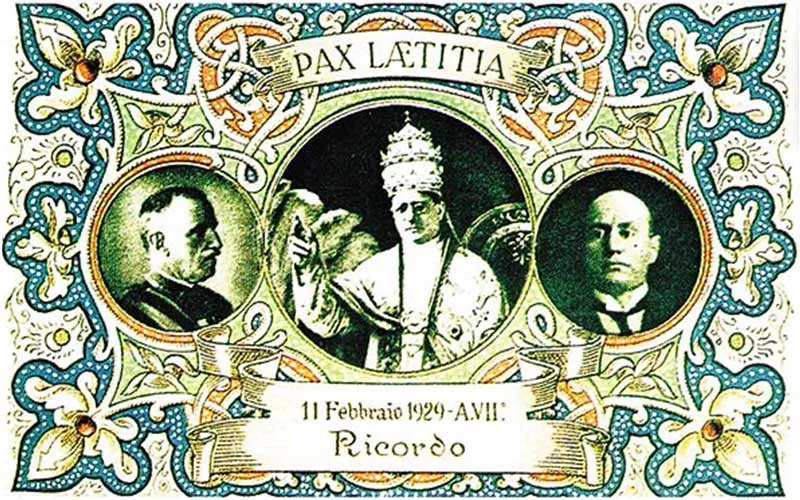
As Mussolini was emerging as the leader of fascism, he decided first to conceal his enmity towards religion, and even to appear as a devout Catholic. He made great efforts to create the image, particularly in the early years of his rule. On the one hand, he had all magazines in which he had written against religion collected and destroyed, while on the other, he made divinity lessons compulsory again after an absence of half a century, and decreed that pictures of the cross and the Virgin Mary should be hung in schools.127 He took great pains in all his speeches to come across as a religious, conservative figure, who was devoted to national customs and traditions. In Mussolini's new view, religion was an institution that owed the state its assistance in order that it should grow stronger.
Mussolini's hypocritical piety was effective, in as much as he won the support of the Church. His "conquest of the heart of the Church" was described in the Encyclopedia of Modern Leaders:
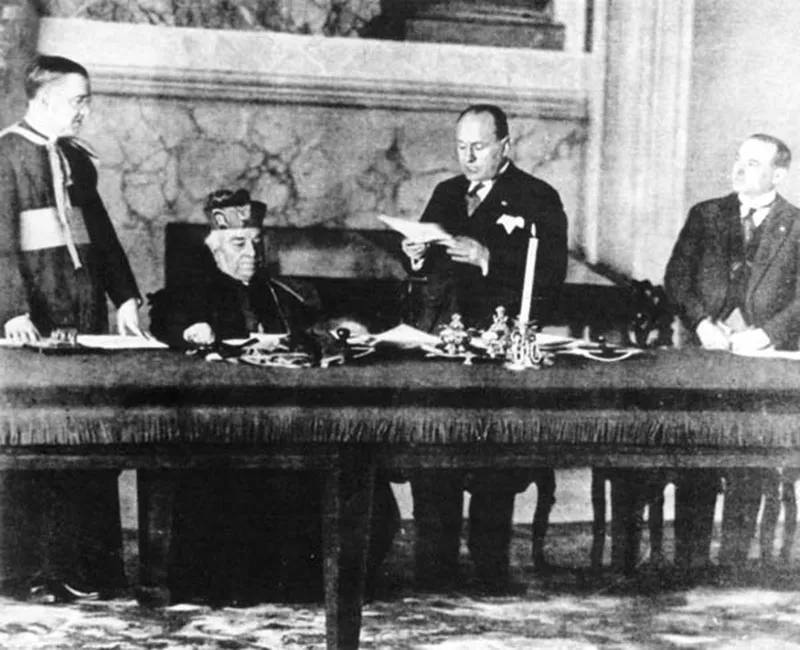
The Church's support for the fascists began with the election of the former Cardinal of Milan as Pope. In Pius XI's view, it was Mussolini who would rescue Italy from anarchy. Relations with Mussolini, who had once waged war against the Church in articles which he signed "A true atheist," and the pro-fascist Pope were always directed towards cooperation. The Vatican newspaper L'Osservatore Romano wrote in February 1923, "Mussolini has been applauded as the man who will restore the fortunes of Italy. This is a victory for religious traditions and national civilization." Cardinal Vicaire called upon the public to support the fascists in the same year. The Vatican withheld its approval of the Catholic Partito Popolare's [People's Party] anti-fascist attitude and had Don Sturzo removed from his post as party leader. In return for this, Mussolini demonstrated his respect for the Church at every available opportunity, staging a religious wedding ceremony for him and his wife, whom he had married 12 years before, and having his children baptized… In February 1929, he restored the Church's rights which had been taken away in 1870 by signing the "Lateran Pact" in the name of the King, with Cardinal Gaspari signing in the name of the Church. Under this agreement, the Church won complete freedom of belief and worship, and Catholicism became the official religion of the state. The Vatican was officially recognized and awarded considerable benefits, the Pope was recognized as head of the state and granted such rights as compensation payments to the papacy, the recognition of Church marriages, and religious lessons in primary schools. In return for these, the Pope awarded Mussolini the order of the "Golden Spur" in 1932, and described him as the "incomparable prime minister."128
But, despite these theatrics, Mussolini was nevertheless an atheist. Once having rallied Italian society behind him, he began to show his real aim, that of completely doing away with religion. In the 1930s, religious doctrines were slowly eliminated, and in their place a form of paganism that revered Mussolini as a divine being was put in place. Mussolini's only true religion was his egotism, which he tried little by little to make the Italians accept.
The slogan mentioned below, during this period, is a testament of the "cult dedicated to Mussolini": "Do not delay for an instant in loving God. But remember that the god of Italy is the Duce." 129
Mussolini belittled religious notions and re-interpreted them according to his own pagan belief system. The fact that he called the decrees and pronouncements he issued the "Fascist Decalogue," reveals the scale of his arrogance and hypocrisy.
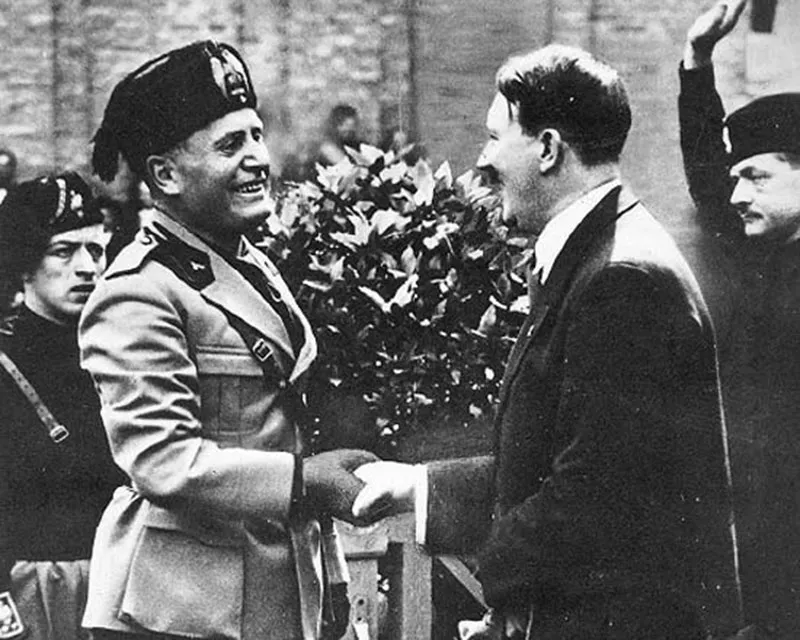
However, Mussolini's arrogance did not endure long. Italy entered the Second World War on the side of Germany, but was defeated, collapsing much earlier than Germany. In 1943, Mussolini was arrested by his own countrymen and imprisoned. He was rescued with Hitler's support, and held out against the opposition in the North for some time longer. Towards the end of the war, he was once again arrested as he tried to cross the border in a German uniform, and was shot with his mistress at his side. His corpse was suspended by one foot in a square in Milan. Such was the dreadful end of a psychopath who claimed he was a "divine being."