Trilobites: Marvelous Life Forms That Lived 530 Million Years Ago
Fossil Trilobite
Reading time: ~2 min read
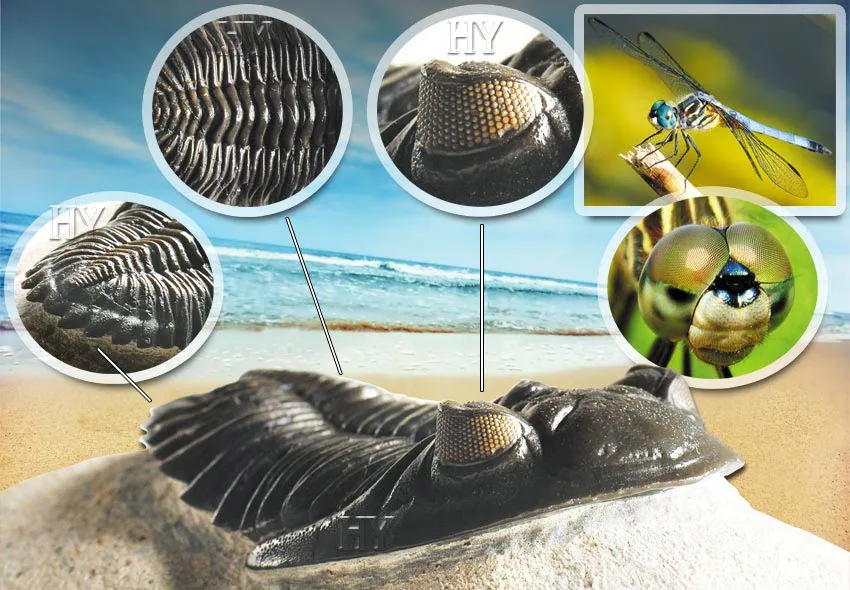
One characteristic of Cambrian fossils is that they’ve been so very well preserved. During fossilization under normal conditions, the hard part of the outer shells, consisting of chitin and calcium, should be decayed or dispersed. Yet in the great majority of specimens collected from Cambrian rocks, the exoskeletons maintain nearly all their original forms, and their owners’ main internal systems can also be seen.Each wide, hemispherical eye may had hundreds or even thousands of lenses, each of which perceived an image from a different direction. Some faced straight forwards, others to the side, and some even faced backward. Each lens focused on an area determined for it. The trilobite was thus able to perceive danger approaching from any direction, and also possessed a great advantage when hunting.Period: DevonianAge: 417 - 354 million yearsRegion:Morocco The body of a trilobite consisted of various segmented sections, all joined together. Each was connected to the adjoining ones with a hinge, forming a linked system much like modern railway carriages. By means of this segmented body, these creatures could easily move over obstacles, flex and turn.14 14The trilobite had the same compound eye structure as that of the present-day housefly, shown above. Some species of trilobite had thousands of lenses in their eyes. Every lens perceived a separate image of the region it focused on. The greater the number of lenses, the greater the resolution of the image. Perfect trilobite eyes, dating back half a billion years, are truly a marvel of creation One of the most important characteristics of the trilobite eye is its "calcite crystals." Calcite crystal, or calcium carbonate, is the building block of pyramids, amphitheaters and historic columns that have survived the centuries down to the present day. And this gave rise to the compound eyes in these life forms. 15