

Reading time: ~3 min read
It has long been known that it is difficult to distinguish between Galapagos finches because of their similarity. Ornithologists have often written that doing so requires considerable expertise.243 Therefore, the classification of these finches into 14 separate species is the subject of controversy among ornithologists.
To recapitulate, a species is defined as a population consisting of individuals with similar structural and functional characteristics, able to mate only with one another in nature, and which are unable to mate successfully with other individuals outside their own population. According to this definition, it is incorrect to divide Darwin's finches into 14 distinct species, because a significant proportion of them have been observed to interbreed. Indeed, Professor Grant admitted that six separate species could be recognized instead of 14, and in later studies he admitted that this figure could be lowered still further.244

Genetic investigation of the Galapagos finches has shown that there is no genetic difference among them.245 For example, a joint study by researchers from the Max Planck Institute and Princeton University in 1999 announced that the traditional classification of Galapagos finches was not apparent at the molecular level.246 Hau and Wikelski express the same:
"There is no evidence for an absolute genetic barrier between Darwin's finch species, thus many species can potentially hybridize.247
In conclusion, the Galapagos finches are all subspecies of a single species. What Darwin saw on and imagined to be evolution was actually variation. Finches with the different appearances in question are in reality variations within a single species. There is no question of any new species emerging.
There is a good reason for evolutionists' insistence on the finches; because finches are one of the groups exhibiting the greatest variation among bird families.248 As a result, they have been widely used in attempts to employ variation as evidence for evolution.
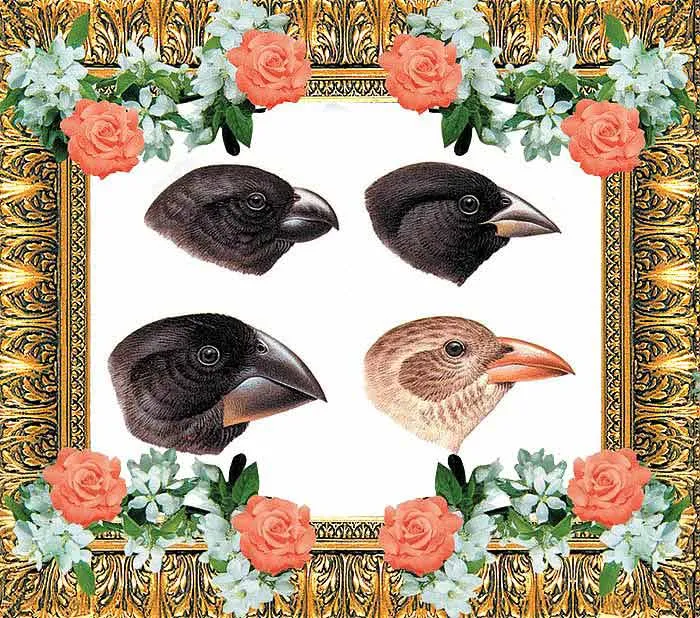
To see how the situation on the Galapagos Islands is a typical case of variation, we can look at another example: In 1967, 100 finches all belonging to the same species were captured on the Island of Laysan in the Pacific Ocean and transported to Southeast Island, some 500 kilometers distant. Observations carried out 20 years later in the 1980s showed that the birds' beak structures were different from how they'd been initially.249 This study is just one example showing broad diversity in finches as a whole. Dr. Lee Spetner, the Israeli physicist and author of the book Not by Chance!, states that what can be observed here is not evolution, but the potential for variation that already existed in those first 100 birds transported to the island.250
As described earlier, variation is no evidence of evolution, because it consists only of the emergence of various different combinations of existing genetic information and adds no new characteristics. The natural selection of variations belonging to a species is the phenomenon that evolutionist biologists refer to as micro-evolution. Since this cannot bring about a species change or produce new genetic information, it provides no evidence for the theory of evolution.
New variations might appear if different combinations of Galapagos finches mated for millions of years or were subjected to different climatic environments. But no matter what happened, they would still remain finches.
In short, absolutely nothing about the variations in the Galapagos finches, regarded as "proof of evolution" by Darwin and his followers, constitutes evidence for the theory of evolution. There are insuperable genetic barriers between species, and small fluctuations in finches' beaks are no evidence that these barriers can be overcome. Instead of placing their hopes in tales about the Galapagos finches, evolutionists must answer the question of how brand-new genetic information to create a new species comes into being originally. Darwinism has no rational and scientific answers to give, and the proponents of the theory of evolution are well aware of this.
References
- Dr. Robert Rothman, "Darwin's Finches", 2001, http://www.rit.edu/~rhrsbi/GalapagosPages/DarwinFinch.html. ↩
- Peter R. Grant, Op.cit., pp. 127–139. ↩
- James L. Patton, "Genetical processes in the Galapagos," Biological Journal of the Linnean Society, Vol. 21, 1984, pp. 91-111; Nancy Jo, "Karyotypic Analysis of Darwin's Finches," in R.I Bowman, M. Berson, A.E. Leviton (editors), Patterns of Evolution in Galapagos Organisms, CA: Pacific Division, AAAS, San Francisco, 1983, pp. 201-217. ↩
- A. Sato, C. O'hUigin, F. Figueroa, P.R. Grant, B.R. Grant, H. Tichy, J. Klein, "Phylogeny of Darwin's finches as revealed by mtDNA sequences", Proceedings of the National Academy of Sciences, vol. 96, Issue 9, 27 April 1999, p. 5101-5106. ↩
- Michaela Hau, Martin Wikelski, "Darwin's Finches," Encyclopedia of Life Sciences, 2000, ğ.els.net ↩
- Lee Spetner, Not By Chance! p. 202. ↩
- Shelia Conant, "Saving endangered species by translocation," BioScience, Vol. 38, 1988, pp. 254-257; S.L. Pimm, "Rapid morphological change in an introduced bird," Trends in Evolution and Ecology, Vol. 3, 1988, pp. 290-291. ↩
- Lee Spetner, Op cit., pp. 204-205. ↩