

Reading time: ~2 min read
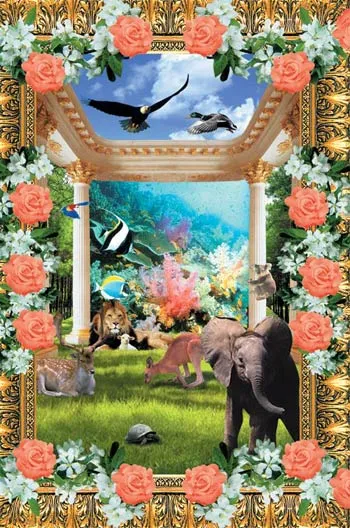
Life can be found just about everywhere on Earth, whether it's visible or not. Almost no place is without life forms of some kind. A vast number of species live in all habitats, in close harmony with both those environments and with one another. From a drop of sea water to the boundless oceans, from a handful of soil to whole continents, from ice caps to thermal springs, from many meters below the ground to the air you breathe, from deep within our bodies to your own skin...
In addition, the Earth plays host to living things with very different body structures, internal systems, forms of behavior and characteristics: From a bacterium just 1 millionth of a meter in size to a giant sequoia tree some 100 meters (328 feet) high and 2,500 tons (5,512,000 pounds) in weight; from deep-rooted trees to terns that fly 20,000 kilometers (12,430 miles) on their migrations or salmon that swim for thousands; from a mayfly with a life span of just a few hours to the creosote bush that can live for more than 1,000 years; from the grouper fish that travel singly through the oceans to ants that live in colonies of several millions; from a delicate orchid to insects that are impervious even to radiation...
As Dr. G. David Tilman, Professor of Ecology from University of Minnesota puts it, "The most striking feature of Earth is the existence of life, and the most striking feature of life is its diversity."2
To describe the variety and richness of life on our plant, scientists use a special term: Biodiversity. This term was adopted from biological diversity and includes animals, plants, fungi and micro-organisms—in short, all living things.
The term biodiversity is now widely employed, but contrary to what is often imagined, it has only recently become a familiar term. No matter how far back in history one researches the variety of life, the special term of biodiversity entered scientific circles only in 1986. That year, the concept was born at the Biodiversity Symposium held by the American National Academy of Sciences and the Smithsonian Institution.3
Following that, there was a rapid increase in initiatives drawing attention to the importance of biological diversity and the need to protect it. Following the United Nations Conference on the Environment and Regeneration, held in Rio de Janeiro in June 1992, biodiversity became one of the subjects of joint concern for all the countries of the world.
References
- David Tilman, "Causes, consequences and ethics of biodiversity," Nature, vol. 405, 11 May 2000, pp. 208-211. ↩
- Marjorie L. Reaka-Kudla, Don E. Wilson, Edward O. Wilson (editors), Biodiversity II: Understanding and Protecting Our Biological Resources, E.O. Wilson, "Introduction," p. 1, Washington D.C.: Joseph Henry Press, 1997. ↩