

Reading time: ~3 min read
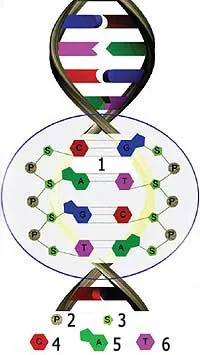
The dual backbones of the long DNA molecule –or the banisters of the staircase– are very strong, made up of consecutive sugar and phosphate molecules. These molecules attach to one another with a special bond known as ester covalent bonds. These are exceptionally strong and it is very difficult to break them. This strength provides protection against harmful factors that might impair genetic information.33 The existence of these bonds makes the DNA molecule resistant and stable even while the DNA molecule is in a single-strand form.
However, there is a risk of damage to the DNA spiral structure as the coils unfold. For that reason, the spiral needs to be strong and stable enough to protect its structure but also elastic enough to be opened up very quickly so that the information can be easily used. In fact, a combination of powerful covalent bonds that protect DNA's basic molecular structure of, and weaker hydrogen bonds that can be broken more quickly, enables the elasticity-solidity problem to be overcome. Since the hydrogen bonds forming between the four opposed nucleotides are not as strong as ester bonds, they can easily be separated with less energy by means of such factors as pH variation (acid-base equilibrium), heat, and pressure. Weak bonds play a very important role in the shaping of the large molecules in an organism, and endow with elasticity the substance they compose. However, no breakage in the bonds ever takes place. Thanks to this distinguishing feature of hydrogen bonds, the information in the DNA molecule can be used whenever required.
The significance of the elasticity in the bonds is that the vital function of protein production is made possible by DNA being copied when cells divide, and that transmission is made possible by the elastic property of the bonds between them. Since the two chains of the DNA molecule are attached to one another only by hydrogen bonds, they can easily be unraveled and separated from one another. They can also, when necessary, recombine and form a new helix structure. No breakage or impairment ever takes place in the nucleotides that constitute the steps of the DNA chain during detachment or separation. While the hydrogen bonds in the center can easily separate from one another, no breakage or stretching ever develops in the long chains at either side, attached by means of covalent bonds. The molecular biologist Michael Denton describes the perfection in the biochemical structure of DNA:
The geometric perfection of the molecule is particularly evident in the fact that the strength of each of the five hydrogen bonds –the two between adenine and thymine and the three between guanine and cytosine– is optimal because each of the hydrogen atoms points directly at its acceptor atom, and the bond lengths are all at the energy maximum for hydrogen bonds. This is most remarkable, for it confers great stability on the molecule and makes for highly accurate base pairing during replication.34
On the one hand, there is a need for a sound and stable structure for the containing of genetic information, while on the other a flexible structure is required for the genes to be read and copied. So the strength of the bond between the two arms that make up the DNA helix has to be just right for it to fulfill its essential functions. And indeed, the DNA helix does have just the right level of strength and elasticity. If the bond between the DNA strips were any stronger, the two arms would stop moving and become fixed. But if the bond were weaker, the molecule would break apart.35 Yet by the will of Allah, the bonds that constitute DNA have the ideal structure to make the helix both highly regular and exceedingly functional.