

Reading time: ~7 min read
The Cambrian—between 543 and 490 million years ago—was regarded as the period during which Cambrian life forms appeared. However, the more fossils were studied, the more it became clear that these species came into being over a much shorter period.
At first, scientists had imagined that Cambrian life forms existed over a period of some 70 million years. Estimates based on the mineral zircon in Early Cambrian fauna proved, however, that this explosion lasted for only around 5 million years, and certainly no longer than 10 million.
This calculation was explained in an article published in Time in 1995:
Zircon dating, which calculates a fossil’s age by measuring the relative amounts of uranium and lead within the crystals, had been whittling away at the Cambrian for some time. By 1990, for example, new dates obtained from early Cambrian sites around the world were telescoping the start of biology’s Big Bang from 600 million years ago to less than 560 million years ago. Now, with information based on the lead content of zircons from Siberia, virtually everyone agrees that the Cambrian started almost exactly 543 million years ago and, even more startling, that all but one of the phyla in the fossil record appeared within the first 5 million to 10 million years.63
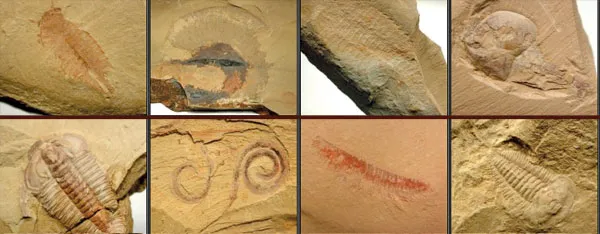
In geological terms, 5 million years is no more than the blink of an eye. This brief period made the fictitious process of evolution, already invalid in so many respects, totally impossible. This added the problem of an inexplicable time frame to that of the inexplicable variety of life that evolutionists were already unable to explain.
In an interview for Time, Samuel Bowring from M.I.T. said:
We now know how fast fast is. . . . And what I like to ask my biologist friends is, How fast can evolution get before they start feeling uncomfortable?64
This is an astonishingly short space of time for some 50 separate phyla and a variety of species—part of which is known to us and part is not—to suddenly emerge with no warning.
Compared with a human being’s life span, 5 million years is certainly a long time. Yet the time frame needed for the fictitious stages that evolutionists claim would allow organisms to diverge and acquire complex characteristics is millions or even billions of years long. Bearing in mind that the Earth is now regarded as being 4.6 billion years old, 5 million years represents just 0.001 of the total age of the Earth, and in relative terms, is just a single instant.65
Jonathan Wells describes this rather brief period this way:
The major increase in animal fossils that marks the Cambrian explosion began about 530 million years ago, and lasted a maximum of 5 to 10 million years. (Although 10 million years is a long time in human terms, it is short in geological terms, amounting to less than 2 percent of the time elapsed since the beginning of the Cambrian.)66
Stephen Jay Gould also commented on this extraordinary speed:
Fast is now a lot faster than we thought, and that is extraordinarily interesting.67
In an article published in Scientific American, Gould described the truth about the Cambrian’s 5-million-year “window” that all evolutionists have had to accept:
Even the most cautious opinion holds that 500 million subsequent years of opportunity have not expanded the Cambrian range, achieved in just five million years. The Cambrian explosion was the most remarkable and puzzling event in the history of life.68
In addition to the complex features of the organisms that suddenly appear in Cambrian rocks, evolutionists must also explain how these creatures came into being in a space of time too short for the lengthy stages of the supposed evolutionary process to have taken place. In as short a space of time as 0.001 of the age of the Earth, could imaginary evolutionary stages have given rise to thousands of creatures, prey and predator, with various and different features, hard shells, perfect eyes and circulatory and digestive systems, in an environment that formerly held only a few, small multi-celled organisms? How might this imaginary process have worked and overcome so many impossibilities? That new life forms emerged in such a short space of time shows that evolution contradicts its own thesis.
As you shall see in a later chapter, evolutionists have attempted to explain this extraordinarily short period of time in various ways, although no account has been at all consistent with the facts.
Here, it will be useful to emphasize that though the various Cambrian life forms appeared within 5 million years, each individual species must have been created at a different time, but in a single moment over those 5 million years. There has been no evolutionary process in this 5-million-year period, just as there has been none in any stage in the history of life.
Allah created these living things for that limited period in history alone, brought them into being from nothing, and did away with them at a moment of His choosing. Indeed, each of the categories that appeared subsequently within the Cambrian phyla did so not by descending from one another. The fossil record makes this crystal-clear. No fossil remains point to an evolutionary relationship among them.
The well-known evolutionist paleontologist George G. Simpson admits as much:
[Paleontologists recognize] that most new species, genera and families, and that nearly all categories above the level of families, appear in the record suddenly and are not led up to by known, gradual, completely continuous transitional sequences.69
In the same way that new species appeared suddenly, they also preserved all their own characteristics and remained completely unchanged, throughout their time on Earth. That is why Gould has written that after the Cambrian almost nothing happened:
The Burgess Shale teaches us that, for the history of basic anatomical designs, almost everything happened in the geological moment just before, and almost nothing in more than 500 million years since."70
The post-Cambrian fossil record, as summarized above by Simpson and Gould, clearly conflicts with the Darwinist idea of gradual development and reveals the two characteristics of sudden appearance and stasis. Gould has explained these two concepts:
The history of most fossil species includes two features particularly inconsistent with gradualism:
- Stasis. Most species exhibit no directional change during their tenure on earth. They appear in the fossil record looking much the same as when they disappear; morphological change is usually limited and directionless.
- Sudden appearance. In any local area, a species does not arise gradually by the steady transformation of its ancestors; it appears all at once and `fully formed.71
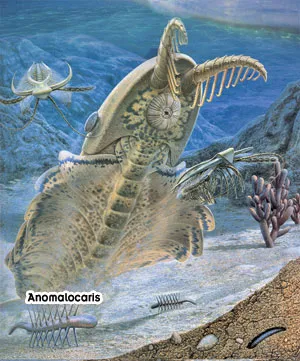
The emergence of Cambrian life forms with all their variety and complexity, across the globe and in a single moment, represents the clearest and absolute refutation of any evolution-based explanation of the origin of living things. Evolutionists have invalidated their own claims by means of the “gradual evolutionary development” thesis they have themselves imposed. There was no gradual development in the Cambrian, much less enough time for one to have taken place. Literally dozens of organisms appeared in a short period of time, each one in a fully formed, advanced state.
Allah created a miracle that would eventually demolish Darwinist claims, and act as a lesson to those looking for explanations other than Allah’s creation leaving them with no alternative account to offer. The remains we see in the Cambrian strata are marvelous works of living art—the flawless work of Almighty Allah, and a manifestation of His omniscience and might.
In the creation of the heavens and Earth, and the alternation of the night and day, and the ships which sail the seas to people’s benefit, and the water which Allah sends down from the sky—by which He brings the Earth to life when it was dead and scatters about in it creatures of every kind—and the varying direction of the winds, and the clouds subservient between heaven and Earth, there are signs for people who use their intellect. (Surat al-Baqara, 164)