

Reading time: ~6 min read
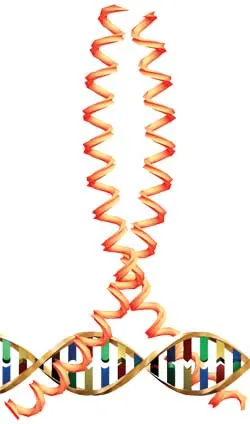
The enzymes that read DNA and engage in production accordingly are also produced according to the codes inside that same DNA. Inside each cell exists a factory that produces a wide range of products and also the structures to produce them. How could this system-a deficiency at any single point of which would render it non-functioning-have emerged on its own? That question is sufficient to demolish the theory of evolution.
The fact that DNA can be copied only with the assistance of a number of enzymes in the protein structure, and that the synthesis of these same enzymes takes place only in line with the information encoded inside the DNA, shows that the protein and DNA are mutually dependent. For that reason, they both must be present right from the outset if the DNA is to be copied itself. The science writer John Horgan clarifies this equation:
DNA cannot do its work, including forming more DNA without the help of catalytic proteins, or enzymes. In short, proteins cannot form without DNA, but neither can DNA form without proteins.194
According to the molecular biologist Michael Denton: "At the heart of the problem lay a seeming paradox-proteins can do many things, but they cannot perform the function of storing and transmitting information for their own construction. On the other hand, DNA can store information, but cannot manufacture anything nor duplicate itself. So DNA needs proteins and proteins need DNA. A seemingly unbreakable cycle-the ultimate chicken-and-egg problem."195 Andrew Scott describes the way that proteins and the genetic code cannot be considered separately in an article in New Scientist magazine:
We are grappling here with a classic "chicken and egg" dilemma. Nucleic acids are required to make proteins, whereas proteins are needed to make nucleic acids and also to allow them to direct the process of protein manufacture itself . . . The emergence of the gene-protein link, an absolutely vital stage on the way up from lifeless atoms to ourselves, is still shrouded in almost complete mystery.196
This situation once again refutes the scenario of life emerging by chance. The American chemist Prof. Homer Jacobson has this to say:
Directions for the reproduction of plans, for energy and the extraction of parts from the current environment, for the growth sequence, and for the effector mechanism translating instructions into growth-all had to be simultaneously present at that moment [when life began]. This combination of events has seemed an incredibly unlikely happenstance. . . .197
Prof. Jacobson wrote these statements two years after James Watson and Francis Crick discovered the structure of DNA. However, despite all the scientific advances that have been made, this problem still remains insoluble for evolutionists. The Turkish evolutionist biologist Prof. Ali Demirsoy was forced to make this admission regarding the probability of protein and DNA coming into being together:
The probability of a protein and nucleic acid (DNA-RNA) is one far exceeding probability estimates. The chances of a specific protein chain emerging are so small as to be astronomical.198
The probability Demirsoy referred is in practice zero. In a 1994 article, the evolutionist Dr. Leslie Orgel said this in the face of that:
It is extremely improbable that proteins and nucleic acids, both of which are structurally complex, arose spontaneously in the same place at the same time. Yet it also seems impossible to have one without the other. And so, at first glance, one might have to conclude that life could never, in fact, have originated by chemical means.199
To say that "it is extremely improbable for life to originate by chemical means" means that it is impossible for life to emerge spontaneously. This is proof that life was created in a single moment. However, evolutionists are reluctant to accept this fact, whose proof they can clearly see, for ideological reasons. They advocate nonsensical scenarios, which they themselves know to be impossible, in order not to have to admit the existence of Allah. Another evolutionist, Caryl P. Haskins, expresses the impossibility of the DNA code forming by chance and sees this as a powerful evidence for creation:
But the most sweeping evolutionary questions at the level of biochemical genetics are still unanswered. How the genetic code first appeared and then evolved and, earlier even than that, how life itself originated on earth remain for the future to resolve. . . . Did the code and the means of translating it appear simultaneously in evolution? It seems almost incredible that any such coincidence could have occurred, given the extraordinary complexities of both sides and the requirement that they be coordinated accurately for survival. By a pre-Darwinian (or a skeptic of evolution after Darwin), this puzzle would surely have been interpreted as the most powerful sort of evidence for special creation.200
Even a single-celled organism has a complexity far exceeding scientists' comprehension. This minute entity contains a genetic code with the stunning capacity capable of forming a copy of the organism all by itself. This code has a structure requiring not just organization, but also written information. Furthermore, it is not enough for this DNA code merely to be written correctly. The rest of the cell must also be able to read the code and follow its instructions. In fact, all living things possess flawless structures that carry out highly organized activities in the light of the directives they receive.
It is certainly impossible for unconscious cell organelles to learn the language of these codes by themselves, or to unravel them as the result of chance. The existence of the code, its decipherment, the transmission of the information it contains, the accurate use made of it-every stage requires consciousness and intelligence. But how can enzymes and ribosomes in the cell know how to perform these activities? Even if we assume that they do know, how can they decipher the codes in a structure of which they are ignorant, without making any mistakes? Such questions not only emphasize the insoluble dilemma facing evolutionists, but also display the infinite intellect and knowledge in creation. In the Qur'an it is stated that:
Your Lord creates and chooses whatever He wills. The choice is not theirs. Glory be to Allah! He is exalted above anything they associate with Him! Your Lord knows what their hearts conceal and what they divulge. He is Allah. There is no deity but Him. Praise be to Him in this world and the Hereafter. Judgment belongs to Him. You will be returned to Him. (Surat al-Qasas, 68-70)