Reading time: ~6 min read

When Darwin's book The Origin of Species was published in 1859, he imagined that his theory could account for life's extraordinary diversity. He had observed that there were natural variations within a living species. Visiting animal fairs in England, for instance, he noted that breeds of cattle were very different, and that farmers could produce new breeds by selective crossbreeding. With this as his starting point, he then pursued the following logic: "Since living things can exhibit variety within themselves, then all of life can have descended from a single common ancestor of the course of long periods of time."
The fact is, however, that his hypothesis did not actually account for the origin of species at all. As the science of genetics advanced, it realized that variation within a species could never lead to a new species emerging. What Darwin imagined to be evolution was in fact variation.
Variation is a genetic phenomenon that causes individuals or groups within a species to exhibit different characteristics. For example, all the humans on Earth possess basically the same genetic information. But thanks to the variation potential that genetic information permits, some have dark skin, others red hair or blond, and some are tall in stature.
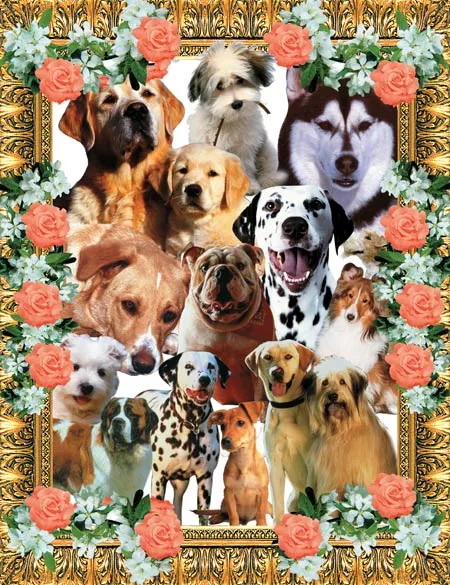
Variation can be very high even within a single species: Not only is there variation amongst humans in the genera and species of the bacteria that invade or live within us, but the organisms themselves often are highly diverse.176 For example, in dogs, one of the living species most familiar to us, there are a large number of variations: bulldogs, Italian poodles, German shepherds, Turkish Kangals, Dalmatians, Chows, Shih Tzus and many more such breeds. There are also many varieties in the fruit and vegetables we eat every day, with different tastes, nutritional contents, shelf lives and other characteristics.
But such variation represents no evidence for evolution. It represents only the emergence of different combinations of already existing genetic information, and does not endow resulting offspring with any new genetic information. The crucial question for the theory of evolution is of how brand-new information that can create—and define—a brand-new species could come into being.
Variation always takes place within the boundaries of genetic information, which bounds are referred to as the gene pool. All the characteristics in a living species' gene pool may emerge at various times, in various forms, thanks to variation. As a result, for example, breeds of reptiles may emerge with a longer tail or slightly shorter legs than others of their species, but the genetic information for a long tail or short legs already exists in the reptiles' gene pool. Yet variation cannot transform reptiles into birds by fitting them out with wings, adding feathers to them and altering their metabolisms. That's because such a transformation requires an increase in genetic information, but in variation, there is no question of such a thing occurring..
Darwin was unaware of all this when he launched his theory. At the time, it was believed that variations had no bounds. In 1844 he wrote: "That a limit to variation does exist in nature is assumed by most authors, though I am unable to discover a single fact on which this belief is grounded."177 In The Origin of Species he attempted to portray various examples of what were actually variation as the greatest evidence for his theory. In Darwin's view, for instance, crossbreeding different variations of cattle in order to produce cows with a greater milk output would eventually turn cattle into an entirely new species. The best expression of Darwin's idea of "unbounded change" is in these words from The Origin of Species:
I can see no difficulty in a race of bears being rendered, by natural selection, more and more aquatic in their structure and habits, with larger and larger mouths, till a creature was produced as monstrous as a whale.178
The reason why Darwin was so confident in his examples lay in the primitive level of scientific understanding in his day. As the result of similar experiments on living things, however, 20th century science revealed the principle known as genetic homeostasis179. This principle revealed that all attempts at crossbreeding were insufficient to change a living species and that between species, there were insuperable genetic barriers. In other words, the livestock breeders who mated different variations of cattle could not have produced another new species, as Darwin claimed. This was absolutely impossible.

Norman Macbeth, author of the book Darwin Retried, has this to say:
The heart of the problem is whether living things do indeed vary to an unlimited extent... The species look stable. We have all heard of disappointed breeders who carried their work to a certain point only to see the animals or plants revert to where they had started. 180
Luther Burbank, one of the most eminent authorities in the field of livestock raising, wrote that "there are limits to the development possible, and these limits follow a law."181
The biologist Edward Deevey describes how variation always takes place within specific genetic bounds:
Remarkable things have been done by cross-breeding... but wheat is still wheat, and not, for instance, grapefruit. We can no more grow wings on pigs than hens can make cylindrical eggs.
A more contemporary example is the average increase in male height that has occurred the past century. Through better health care (and perhaps also some sexual selection, as some women prefer taller men as mates), males have reached a record adult height during the last century, but the increase is rapidly disappearing, indicating that we have reached our limit. 182
In short, variations give rise to certain changes that always remain within the genetic limits of a species, but never impart to that species any new genetic information. That is why no variation represents an example of evolution. No matter how much you crossbreed different breeds of dogs or horses, the results will still be dogs or horses. No new species will ever appear, as the agricultural scientist Dr. Don Batten summarizes:
... variation within a kind, such as through breeding or adaptation, is not evolution. All the biological genetic "evidence" for evolution is actually variation within a kind, not evolution at all. 183