

Reading time: ~4 min read
One of the superstitions to survive from paganism, but which only began to be revived in Europe in the 18th and 19th centuries, was the "theory of evolution," a theory which maintained that all living things came into existence as the result of pure chance, and then developed from one to another.
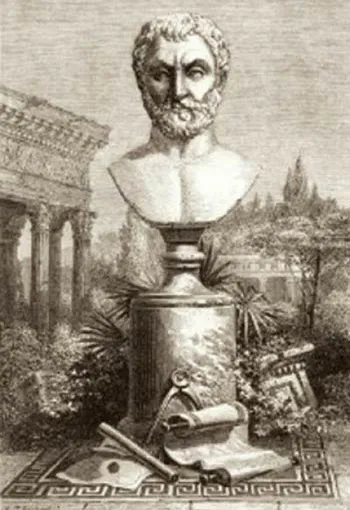
Unaware of the existence of God, and worshipping false idols which they themselves devised, pagans answered the question of how life came about with the concept of "evolution." This notion is first seen in inscriptions from ancient Sumeria, but was given shape in ancient Greece. Pagan philosophers such as Thales, Anaximander and Empedocles, claimed that living things, in other words human beings, animals and plants, formed themselves from such inanimate substances as air, fire and water. According to their theories, the first living things suddenly emerged in water and then adapted to the land. Thales had spent time in Egypt, where the superstition that "living things formed themselves out of mud" was widespread. The Egyptians believed that in this way the frogs which appeared when the waters of the Nile receded were formed.
Thales adopted the superstition and attempted to present a number of arguments on its behalf, proposing that all living things came into existence by and of themselves. These claims of his were based solely in theory, not on experiment and observation. Other ancient Greek philosophers employed the same method.
Anaximander, a student of Thales, developed the theory of evolution, giving rise to to two important modes of Western thought. The first of these was that the universe had always existed and will continue to exist into eternity. The second was the idea that living things evolved from each other, an idea which had slowly begun to take shape in Thales' time. The first written work to discuss the theory of evolution was the classical poem On Nature, in which Anaximander wrote that creatures arose from slime that had been evaporated by the sun. He thought that the first animals lived in the sea and had prickly, scaly coverings. As these fish-like creatures evolved, they moved onto land, shed their scaly coverings, and became humans.6 Books on philosophy describe how Anaximander shaped the foundation of the theory of evolution:
We find that Anaximander of Miletus (611 B.C.-546 B.C.) advanced the traditional evolutionary idea, already quite common in his day, that life first evolved from a type of pre-biotic soup, helped along a bit by the rays of the sun. He believed that the first animals developed from sea slime which had been evaporated by the sun rays. He also believed that men were descended from fish.7
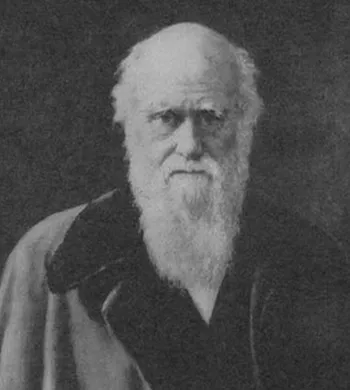
In short, one of the two fundamental components of Darwinism, the claim that living things evolved from each other as a result of coincidences, was the product of pagan philosophy. The second important element of Darwin's theory, "the struggle for survival," was also a pagan belief. It was the Greek philosophers who first suggested there was a war for survival between living things in nature.
The notion of evolution, which the pagan philosophers had construed, not by experiment and observation, but by abstract reasoning, began to be reiterated in 18th century Europe.
In pagan thought, the concept of evolution was called "the Great Chain of Being," an idea that influenced such early defenders of evolutionary theory as the French scientists Benoit de Maillet, Pierre de Maupertuis, Comte de Buffon and Jean Baptiste Lamarck.
In his Histoire Naturelle, Buffon reveals himself as "an exponent of the doctrine of the Great Chain of Being, with man being placed at the tope of the Chain."8 Buffon's evolutionist views were passed on to Lamarck, and eventually inherited by Charles Darwin.
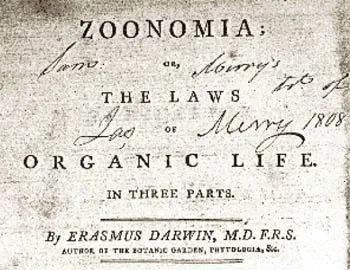
Charles Darwin's grandfather, Erasmus Darwin, was an evolutionist who adhered to pagan beliefs. From the research he carried out in his eight-hectare botanical garden, he developed the ideas that would later go on to shape Darwinism, collected together in his books The Temple of Nature and Zoonomia. The concept of "the temple of nature" that Erasmus employed was a testament to the pagan beliefs he adopted, a repetition of the old pagan belief that nature possesses a creative force.