

Reading time: ~3 min read
In the wake of The Origin of Species and The Descent of Man, a great many evolutionists began speculating how human social behavior, emotions, judgments and ideas—all attributes of the human spirit—might have been shaped by evolution. According to the most widespread error, if our bodies' appearance and functioning were shaped by evolution, then the behavior our bodies exhibit must have been shaped by evolution, too. Evolutionists, unable to account for how the biological structures in living things came into being, now began inventing tales regarding the so-called evolution of the human soul.
In The Descent of Man Darwin claimed that in the future, evolution would constitute the foundation of psychology, and expressed his illusory claim in these terms:
In the distant future I see open fields for far more important researches. Psychology will be based on a new foundation, that of the necessary acquirement of each mental power and capacity by gradation. Light will be thrown on the origin of man and his history.181
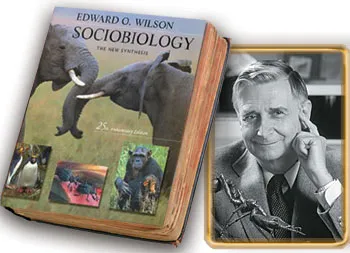
The first comprehensive initiative to account for the origins of human and animal behavior in evolutionary terms came from Harvard entomologist Edward O. Wilson. Despite the complete failure of Wilson's initiative, it came to be known as "sociobiology."
In Sociobiology: The New Synthesis, published in 1975, Wilson maintained that animal behavior had a completely biological foundation. Basing his error on biological evolution, he thought that particular genes controlled human and animal behavior. His true field of expertise was insects, which he referred to in the first 26 chapters of his book. In the 27th chapter, he attempted to adapt these claims to human beings. His 1978 book Human Nature speculated that human genes were responsible for such behavior as hatred, aggression, xenophobia, amicability, homosexuality and characteristic differences between men and women. None of Wilson's claims went any further than conjecture.
None of the claims made by him and his supporters have ever been backed up by scientific findings. On the contrary, all scientific data have shown that his ideas are utterly mistaken.
Another of Wilson's unscientific claims is that living things are nothing more than gene carriers, and that their most important responsibility is to transmit those genes to subsequent generations. In his view, evolution is actually the evolution of genes. In his book Sociobiology: The New Synthesis, he expresses this unscientific claim thus:
In a Darwinist sense, the organism does not live for itself. Its primary function is not even to reproduce other organisms; it reproduces genes, and it serves as their temporary carrier. Each organism generated by sexual reproduction is a unique, accidental subset of all the genes constituting the species. Natural selection is the process whereby certain genes gain representation in the following generations superior to that of other genes located at the same chromosome positions. ... But the individual organism is only their vehicle, part of an elaborate device to preserve and spread them with the least possible biochemical perturbation. Samuel Butler's famous aphorism, that the chicken is only egg's way of making another egg, has been modernized: the organism is only DNA's way of making more DNA.182
Wilson's claims were solely the result of evolutionist preconceptions. Even among evolutionists, some objected to Wilson's conjecture. One of them was Stephen Jay Gould:
But Wilson makes much stronger claims. Chapter 27 ... is primarily, an extended speculation on the existence of genes for specific and variable traits in human behavior – including spite, aggression, xenophobia, conformity, homosexuality, and the characteristic behavioral differences between men and women in Western society.183
With the evolutionist zoologist Richard Dawkins, evolutionist speculation concerning human behavior that began with Wilson reached an unbelievable and illogical peak.