

Reading time: ~5 min read

As a result of the unscientific claims made about genes by sociobiology and its extension, evolutionary psychology, the "selfish gene" deception was put forward and popularized by Richard Dawkins.
According to him, a living thing's most important objective is survival and reproduction—in short, protecting its genes and passing them on to subsequent generations. This claim is entirely speculation.
According to this conjecture of the theory of evolution, inanimate chemical substances at one time organized themselves (however that actually happened), and established a DNA-based system capable of reproducing itself. The first organism to emerge from this imaginary chemical soup was a gene with no purpose other than to multiply. Somehow, it "decided" to copy itself, and began doing so, producing new genes. As a result of errors during this copying process, genes with different features emerged. Later, these genetic materials "learned" in some way how to constitute various bodies and thus reproduce these genetic materials more effectively. The genes that encoded the best body were thus copied more effectively than others. Evolutionists maintain that as a result of this, the how and why of which they can't account for, bodies gradually developed in terms of form and function. This story, which could not possibly have taken place, constitutes one of the fundamental claims of modern Darwinism. Yet evolutionists are also perfectly well aware that it is impossible for the human body, any organ in it, the cells that comprise such organs, or even a single component of these cells to have brought itself into being.
Dawkins, however, took this myth as his starting point and claimed that there is "competition" between genes. He set out his distorted view of humanity in his book The Selfish Gene:
We are survival machines—robot vehicles blindly programmed to preserve the selfish molecules known as genes. This is a truth which still fills me with astonishment. Though I have known it for years, I never seem to get fully used to it. One of my hopes is that I may have some success in astonishing others...184

According to Dawkins' illogical claim, a human being is simply a gene-bearing robot. Its only reason for existence is to multiply the genes it bears, support them in competition with other genes, and to pass them on to subsequent generations. It is evident that this claim, ignoring the existence of the soul and regarding the human being as a mechanical device, lacks any realistic aspect.
Nonetheless, the majority of evolutionists seeking a materialist explanation have supported this unscientific theory of Dawkins'. In his book Human Nature, Wilson maintains that human beings acquire importance and purpose only through their genes:
... no species, ours included, possesses a purpose beyond the imperatives created by its own genetic history (i.e., evolution)... The species lacks any goal external to its own biological nature.185
According to this materialistic belief with no scientific foundation, if the continuation of genes is the only aim, then the human beings responsible for protecting them must be as selfish and ruthless as possible in the interests of their genes. According to Dawkins and his supporters, "selfish" genes will be victorious in that competition. In The Selfish Gene, Dawkins summarizes this perverted Darwinist viewpoint:
We, and all other animals, are machines created by our genes. Like successful Chicago gangsters, our genes have survived, in some cases for millions of years, in a highly competitive world. This entitles us to expect certain qualities in our genes. I shall argue that a predominant quality to be expected in a successful gene is ruthless selfishness. This gene selfishness will usually give rise to selfishness in individual behavior. However, as we shall see, there are special circumstances in which a gene can achieve its own selfish goals best by fostering a limited form of altruism at the level of individual animals. "Special" and "limited" are important words in the last sentence. Much as we might wish to believe otherwise, universal love and the welfare of the species as a whole are concepts that simply do not make evolutionary sense.186
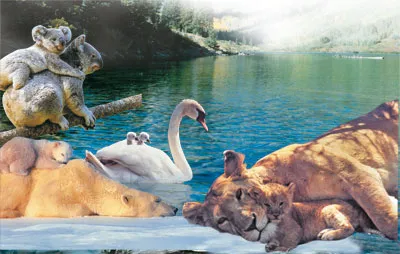
According to Dawkins' ignorance, since the genes borne by human beings are selfish, man must be selfish, too. That being so, "selfish robots" can be expected to resort to any measures in order to protect and preserve their genes. There is no longer any reason not to commit murder, theft or rape. One cannot expect "selfish machines" to obey any moral law, or to behave in a conscientious, ethical way. Under these circumstances, the killing of one human being is not a crime or immoral, but a genetic compulsion to further one's own interests. Since genes are selfish, so is their behavior. Dawkins' view of human beings is exceptionally dangerous and implies the fragmentation of social morality.
In fact, however, the selfish gene claim is illogical and nonsensical, since Dawkins and others like him describe genes as entities with consciousness and willpower. Yet genes are long chains of DNA—spiral ladders of nucleic acids held together by sugar and phosphate strands. In the same way that H2O (water)or H2SO4 (sulfuric acid) are molecules, so is DNA a molecule. In the same way that it is impossible to speak of "selfish water," "selfish salt" or "jealous sulfuric acid," neither can one speak of "selfish genes."
Evolutionists depict human beings as collections of matter, and somehow try to ascribe reasoning somewhere within that assortment. That they can ascribe reasoning and consciousness to genes shows how inconsistent the theory of evolution has become. Today, Darwinism maintains that there is reason and consciousness in molecules, and in the inanimate atoms that comprise these molecules, and has replaced the paganism that ascribed reason and consciousness to idols of stone or wood.