

Reading time: ~5 min read
Marx and Engels' followers, who brought about the deaths of millions of people and were the reason for hundreds of millions of others living in pain, fear, and violence, accepted the theory of evolution with great joy and interest.
John N. Moore speaks of the links between evolution and the Soviet leaders who implemented Marx and Engels' ideas in Russia:
The thinking of the leaders of the USSR is rooted deeply in an evolutionary outlook.88
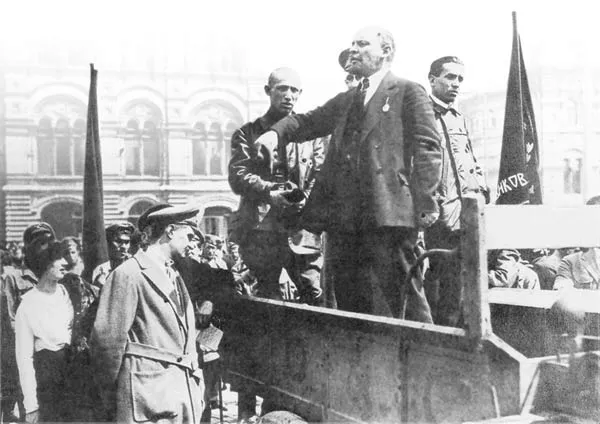
It was Lenin who made Marx's project of Communist revolution come true. Lenin, the leader of the Communist Bolshevik movement in Russia, aimed to bring down the Tsarist regime in Russia by force of arms. The chaos after World War I gave the Bolsheviks the opportunity they had been seeking. With Lenin at their head, the Communists seized power by the use of arms in October 1917. After the revolution Russia was the scene of a bloody three-year civil war between Communists and supporters of the tsar.
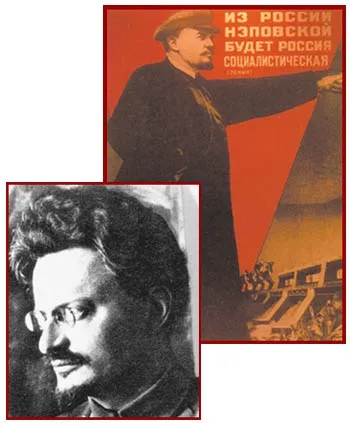
Like the other Communist leaders, Lenin often stressed that Darwin's theory was the fundamental basis of dialectical materialist philosophy.
One of his statements reveals his view of Darwinism:
Darwin put an end to the belief that the animal and vegetable species bear no relation to one another, except by chance, and that they were created by God, and hence immutable.89
Trotsky, counted the most important architect of the Bolshevik revolution after Lenin, again attached great importance to Darwinism. He declared his admiration for Darwin in the following way,
Darwin's discovery is the highest triumph of the dialectic in the whole field of organic matter.90
Following Lenin's death in 1924, Stalin, widely regarded as the bloodiest dictator in the history of the world, passed to the leadership of the Communist Party. Throughout his 30 years in power, Stalin would try to prove just what a ruthless system Communism was.
Stalin's first important move was to take over the fields of the peasants who made up 80 percent of the population of Russia in the name of the state. In the name of this policy of collectivisation which was intended to do away with private property, all the Russian villagers' crops were collected by armed officials. As a result there was a terrible famine – millions of women, children, and the elderly who could find nothing to eat ended their lives writhing in hunger. The death toll in the Caucasus alone was 1 million.
Stalin sent hundreds of thousands of people who tried to resist this policy to Siberia's dreadful labour camps. These camps, where the prisoners were worked to death, became the grave of most of these people. On the other hand tens of thousands of people were executed by Stalin's secret police. Millions of people were forced to migrate to the furthest corners of Russia, including the Crimean and Turkestan Turks.
By these bloody policies Stalin killed some 20 million people. Historians have revealed that this savagery gave him enormous personal pleasure. It gave him great pleasure to sit at his desk in the Kremlin and examine the lists of those who had died in the concentration camps or who had been executed.
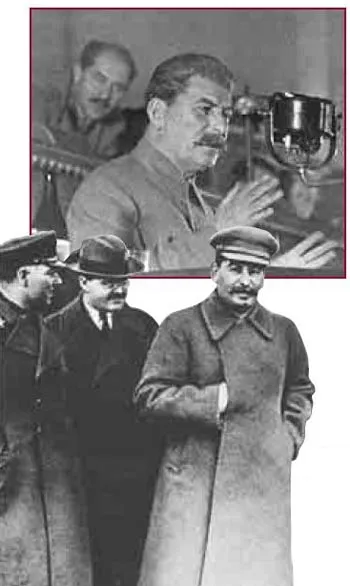
Apart from his personal psychological state, the main influence which lead him to become such a ruthless killer was the materialist philosophy he believed in. In Stalin's own words, the fundamental basis of this philosophy was Darwin's theory of evolution. He explained the importance he attached to Darwin's ideas:
There are three things that we do to disabuse the minds of our seminary students. We had to teach them the age of the earth, the geologic origin, and Darwin's teachings.91
While Stalin was still alive a close childhood friend of his recounted how Stalin had become an atheist in the book Landmarks in the Life of Stalin:
At a very early age, while still a pupil in the ecclesiastical school, Comrade Stalin developed a critical mind and revolutionary sentiments. He began to read Darwin and became an atheist.92
In the same book, G. Glurdjidze, a boyhood friend of Stalin's relates how Stalin had stopped believing in God and had told him that the reason for this was Darwin's book, pressurising him into reading it too.93
One important indication of Stalin's blind faith in the theory of evolution was the Soviet education system's rejection of Mendel's genetic laws in the period when he came to power. These laws, which had been accepted by the whole world of science since the start of the 20th century, denied Lamarck's claim that "acquired traits can be passed on to later generations." The Russian scientist Lysenko saw this as a heavy blow to the theory of evolution and at the same time a great danger, and told Stalin his ideas. Stalin was impressed by Lysenko's ideas and made him head of the official scientific associations. Thus genetic science, which had dealt a heavy blow to evolution, was not accepted in any Soviet Union scientific association or school until Stalin's death.
In Stalin's period the Soviet Union had turned into an environment of chaos where for millions of people life was permanently under threat, and where they could be taken away, though innocent of any crime, at any moment, to suffer unimagined torments. Not just Communism, but the history of Fascism, too, is full of such attitudes.
It is an obvious and definite truth that bloody leaders such as Lenin, Stalin, Mao, Hitler and Mussolini, and the ideologies they espoused all drank from the same well and that they were all portrayed as justified and the only way by the same source. In short there was also another guilty party behind these people. The cause of these inhuman and unbalanced leaders dragging millions along behind them, and which allowed them to commit crimes, was the apparent scientific force and support given to them by materialist philosophy and Darwinism.