

Reading time: ~1 min read
The claim is put forward in the Scientific American article that "our ancestors'" progress in increasing the energy obtained from food and raising its nutritional quality was one of the main features in mankind's evolution and splitting away from the other primates. Yet from the scientific point of view, this claim is totally without foundation. Better-nourished living things may have stronger bodies, and may be healthier and live longer. However, improved nutrition cannot cause them to turn into another species.
That is because there is no connection between nutrition and man's genetic make-up. In order for a "speciation event" to happen, the genetic structure needs to change to a considerable extent and to be redesigned. Such a thing has never, ever been observed in nature, and nutrition cannot affect genetic structure.
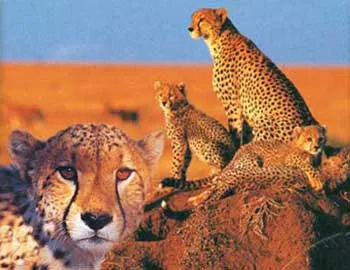
We can see this for ourselves: A cheetah community living in an area where prey is plentiful, and which therefore has no need to compete with other predators, may grow stronger because it consumes more meat. Yet it is impossible for these cheetahs to evolve into lions. That is because cheetah DNA and lion DNA are different, and there is no relation between food intake and DNA structure. DNA base pairs are set out in strings in a particular sequence in all living species. That specific sequence gives rise to the living thing's genetic code, which is handed down unchanged from generation to generation. It is therefore impossible for nutrition to have played any role in mankind's so-called evolution. Claiming that nutrition can influence genetics and bring about "evolution" is no less of a superstition than Lamarck's thesis of "the inheritance of acquired traits."