

Reading time: ~4 min read
It is impossible to account for the design in birds and the flight motion dependent on that design in terms of evolution. Flight possesses the most complex aerodynamic properties, both in birds and in insects. The control of flight in birds and insects requires a nervous system capable of flawlessly controlling the creature's muscles. In this system, known as neuromuscular control, the nerve cells are in constant communication with the muscle cells. After contracting with the instructions received from the nerve cells, the muscles send back a signal reporting their contracted state. When a bird rises, glides, or descends, this system is ready to provide the necessary aerodynamics.
The perfect flight systems in birds and insects is a source of inspiration for engineers, who try to create the most productive designs with the best materials for the lowest cost, and who have begun to imitate this superior design in nature. For instance:
Like bird bones, the interiors of airplane wings are hollow. There are long, thin supports between the internal faces of the bone in order to maintain resistance. In flight engineering, similar struts inside the wing serve the purpose of a skeleton in the face of sudden and severe air currents. Known as the "Warren's truss," it has been copied from birds.9
The flaps on the plane wing used to control the plane's attitude have been set out to imitate the movement of the bird's wings as it comes in to land.
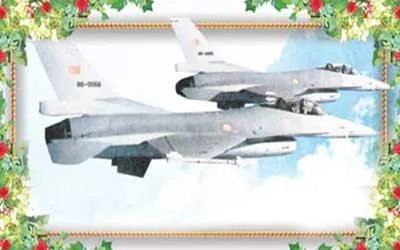
The shape of the nose in birds and planes is such as to reduce air resistance.
The ability of modern-day planes to make sudden maneuvers in the air is much less than that of birds. The understanding of the aerodynamic systems of birds in flight is of the first importance in the production of more maneuverable planes. That is in fact the reason for the funding received for Kenneth Dial's study described above. William Zamer of the American National Science Committee, which funded the research, says, "The results may also one day help humans design better vehicles for both land and air travel."10 This reveals just how superior the aerodynamic control ability in partridges is.
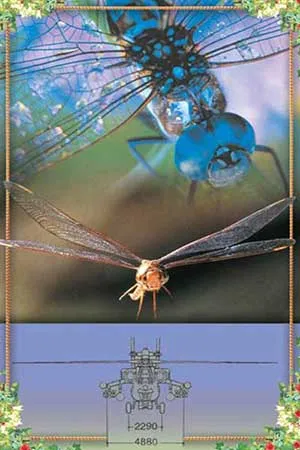
Despite being much smaller than birds, insects have also fascinated those engineers who have studied the way they fly. For example, a fly can flap its wings an average of 500 times a second, and can instantaneously change direction. The superior design in the dragonfly, which can remain suspended in the air or suddenly change direction at high speed, was imitated in the design of the American Sikorsky helicopter.
Engineers trying to imitate insect flight encounter a major difficulty here. Fly wings rotate in the air in a figure-eight pattern. The surface of the wing points upwards in the first half of the rotation and down in the second half. In order to imitate this, jointed rotating wings would need to be mounted on a plane. Even harder than that is the computer system to allow such wings to move rapidly and in a controlled manner. The construction of such a system is beyond our wildest dreams with the current level of our technology. The greatest dream of engineers imitating insect flight is to be able to create robot insects whose flight can be controlled in narrow corridors and rooms. Experts working in high technology institutes in America state that in terms of imitating insect flight they regard themselves as being at the level of the Wright brothers in 1903.11
References
- "Flying High," An interview with Dr. Andy McIntosh, http://www.answersingenesis.org/home/area/magazines/docs/v20n2_mcintosh.asp ↩
- "Study: Frantic Flapping May Have Led to Flight," ABCNews, January 16, 2003, http://abcnews.go.com/wire/SciTech/reuters20030116_443.html ↩
- "Robotic Insect Takes to the Air," Dr.Chris Riley, BBCNews, April 11, 2001, http://news.bbc.co.uk/2/hi/science/nature/1270306.stm ↩