

Reading time: ~3 min read
Dial's claim rests on certain observations of the Alectoris chukar species of partridge. One feature of these birds is that they prefer to run up a steep incline or tree trunk rather than fly. As they run, they also flap their wings to gain speed. This short-distance running was given the name Wing-Assisted Incline Running (WAIR).
During WAIR, as the partridges run up the slope, they both use their feet and flap their wings, thus reducing the effect of gravity. Their feet are designed in such a way as to cling to the ground, and their wings function like the ailerons on a racing car. As a result of Dial's research, he observed that chicks possessed almost the same WAIR ability as adult birds. He described how within four days of hatching birds were able to climb up 45 degree inclines in this manner, and that their still-growing wings had an aerodynamic effect during this sprint.
A number of experiments were conducted on these developing wings, and Dial saw that the aerodynamic effect on wings with shortened feathers decreased. Birds with trimmed feathers were unable to climb as well as birds whose feathers had not been trimmed.
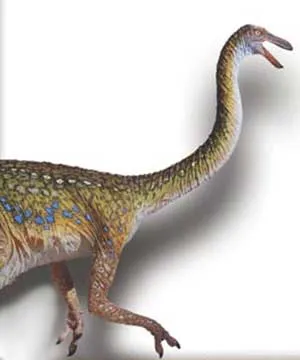
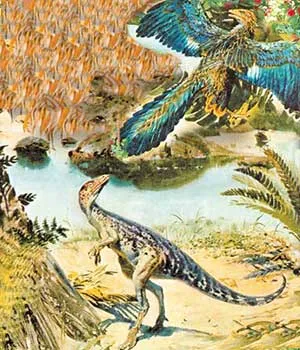
Dial, an evolutionist, maintains that the origin of birds goes back to dinosaurs of the theropod subgroup. He favors the idea that dinosaurs are the ancestors of birds and tries to place his observations of the partridge uphill sprint somewhere into the illusory dino-bird evolution.
According to the scenario he came up with, dinosaurs trying to escape from predators flapped their forearms when running on inclines in order to gain speed, and these forearms thus gradually turned into wings. This scenario is totally devoid of any scientific foundation, although he sought to use it as evidence for the imaginary transition from dinosaur to bird.
It is clear that Dial's claim rests on nothing more than imagination. Showing that he was able to reduce the aerodynamic properties of birds' feathers by shortening them brings with it absolutely no scientific explanation of the way that dinosaurs allegedly came to be able to fly. This is nothing but trickery of the kind put forward by many other evolutionists seeking to instill the imaginary dino-bird model in people's minds.
The fact that such a claim was made by a scientist and published in a scientific journal might deceive some people into thinking that such stories possess some kind of scientific basis. The fact is, however, that scientific research actually disproves the dino-bird theory, for which no evidence has ever been forthcoming. Scientific findings in the fields of paleontology, developmental biology, physiology, and anatomy in particular clearly reveal that Dial's claim is nothing more than a fantasy. In addition, a number of advances in the technological arena show that flight and flying creatures have been specially designed. This fact eliminates the evolutionists' groundless and invalid claims that living things evolved as the result of a series of coincidences.