

Reading time: ~7 min read

Since Darwinism is not founded upon any genuine scientific evidence or basis, it seeks to gather support by presenting false evidence. It is therefore enough for Darwinists to have materials on which to speculate in their possession. Darwinists take fossils of extinct life forms that they can speculate about, shape them in various ways and use them as tools for their ideology. The Coelacanth, which as it was supposedly extinct, was for years portrayed as the best known example of the imaginary transition from water to land, but a living specimen of which was subsequently caught in today's waters, is the most important evidence of this fraud. Darwinists try to use the same tactic for other life forms and for man. They categorize all the fossils they acquire on the basis of their appearance and attach the label of "transitional form" to whichever take their fancy. But all the fossils they describe as "transitional forms" belong, like the Coelacanth, to perfect and flawless living things.
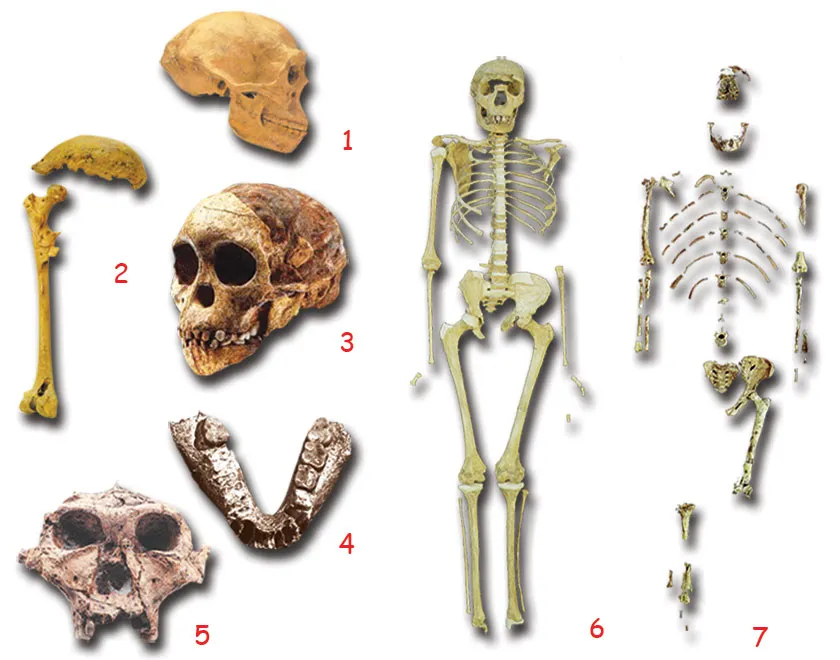
The invalidity of all the fossils heralded as transitional forms has subsequently been proved, and it has been scientifically established that they all belong to complex, extinct life forms. When it comes to the supposed evolution of man, the tools of speculation are generally either extinct types of ape or else certain human peoples who lived at some time in the past. All the "transitional form" claims made to date have been based on this speculative technique. For example, countless skulls that Darwinists have attempted to portray as examples of the fictitious evolution of man, have been definitely and scientifically proven to belong to extinct forms of ape or else human races. And the skulls in question have all been removed from the scientific literature:
- A fossil discovered in 1891 and given the name Java Man, and the fossil known as Peking Man discovered in 1923 were both shown to be false transitional forms in 1939.
- A single fossil tooth, claimed to represent the most significant evidence of a transitional form in 1922 and given the name of Nebraska Man, was realized to belong to a wild pig in 1927.
- A fossil discovered in 1959 and named Zinjanthropus was subsequently realized to belong to an ordinary ape and was removed from the scientific literature in 1970.
- Ramapithecus, discovered in the 1930s and exhibited as a transitional form for the next 50 year, was eliminated when it was shown to be an ordinary baboon in 1981.
- Lucy, discovered in 1974 in Africa was invalidated by research in 1999-2000, and the fossil was also removed from the scientific literature.
- The skull named the Taung Child discovered in 1924 was invalidated in 1954 when it was shown to belong to a young gorilla.
- It was established that the Turkana Boy fossil discovered in 1984 and attempted to be portrayed as a Homo Erectus, was in fact about 12 years old, and would have stood 1.83 meters tall when he became an adult. The erect structure of the skeleton is in no way different from humans today. It was understood that all the speculation about the fossil was false.
In a statement issued in Nature magazine, the evolutionist L.B. Halstead from the University of Reading Geology Department admitted that all the fossils depicted to date as evidence for so-called evolution, in fact constituted no evidence for human evolution, and that Darwinists actually had no corroborative finds in the area at all:
This presents the public for the first time with the notion that there are no actual fossils directly ancestral to man. [This is] What the creationists have insisted on for years ...62
The biologist Lyall Watson also says that Darwinists have not unearthed a single fossil that might prove the supposed evolution of man:
Modern apes, for instance, seem to have sprung out of nowhere. They have no yesterday, no fossil record. And the true origin of modern humans--of upright, naked, toolmaking, big-brained beings--is, if we are to be honest with ourselves, an equally mysterious matter.63
No matter how reluctant Lyall Watson may be to openly state the case, referring to the origin of man as "a mysterious matter," the origins of man are actually abundantly clear: Allah created man like all other living things, and concrete scientific findings confirm this. In addition to all this, Darwinists are always confronted by the dating problem with every new fossil that is unearthed. They constantly have to "set back" the dates they have dreamed up for evolution and to alter their claims as they see how fossils refute evolution. For example, the fact that 200-million-year-old human footprints were found in one stratum alongside human bones in strata dating back to the Cretaceous Period (144 to 65 million years) shows that human beings go back at least 100 million years.64 Given that evolutionists assume a period of 50,000 years since human beings first appeared, we are most definitely looking at a major discrepancy. New fossils reported in August 2007 showed that the life forms called Homo Erectus and Homo Habilis by Darwinists in fact lived at the same time. The dating problem is yet another factor that leaves Darwinists in a hopeless dilemma when it comes to the so-called evolution of man.
Yet despite all these facts, Darwinists still continue to portray the false fossils in question as evidence and to convert them, in their own eyes, into part of the myth of human evolution. They still deceive people and continue to use these fossils, the invalidity of which has been scientifically proven, in scientific references and school text books. The writer Hank Hanegraaff comments on this deceptive technique:
Speculation about Pithecanthropus Erectus, the ape man that walked erect, is far and away the most famous 'ape-man' fiction still being circulated as fact. While over time he has evolved into a new classification called Homo Erectus, millions regard him as a friendly ancestor, not just a fossil, and simply refer to him by the nickname Java Man.
It is generally known that Java Man was initially discovered by a Dutchman named Eugene Dubois on the Dutch East Indian island of Java in 1891. What is not so well known is the fact that Java Man consists of nothing more than a skullcap, a femur, three teeth, and a great deal of imagination. Even more disturbing is the fact that the femur was found 50 feet (15 meters) from the skullcap and a full year later… This trek, commonly referred to as the Selenka Expedition, included nineteen evolutionists bent on demonstrating that the evolutionary conjectures about Java man were true. However, their 342 page scientific report, which, according to [Sir Arthur] Keith [a famous evolutionist] 'commands our unstinted praise,' demonstrates beyond the peradventure of a doubt that Java mMan played no part in human evolution."
Despite all the evidence, it is truly amazing that Time magazine printed "How Man Began," an article that shamelessly treated Java Man as though it were a true evolutionary ancestor."65
In this way, Darwinist publications become part of the Darwinist deception. Darwinist books written by eminent professors and scientists repeat these false scenarios, which are entirely based on deception, rather than producing genuine scientific evidence. The reason why skulls that have been removed from the scientific literature and whose invalidity has been scientifically established are still kept on the agenda is in order for this deception to be maintained. As the evolutionist zoologist Robert Martin said to New Scientist magazine on the subject:
In recent years several authors have written popular books on human origins which were based more on fantasy and subjectivity than on fact and objectivity...66
At the present moment Darwinists have not a single skull or a single bone fragment they can point to as evidence for supposed human evolution. The fraudulent method employed by Darwinists, who are unable to bear this state of affairs, is to continue to deceive people by way of such false transitional form fossils.
References
- L. B. Halstead "Museum of Errors", Nature, 20 Kasım 1980, s. 280 - Nicholas Comninellis, Creative Defense, Evidence Against Evolution, Master Books, 2001, s. 180 ↩
- Lyall Watson, "The Water People", Science Digest, vol. 90, no. 5, Mayıs 1982, s. 44 - Nicholas Comninellis, Creative Defense, Evidence Against Evolution, Master Books, 2001, s. 181 ↩
- F. A. Barnes, Desert Magazine, 38: 36-39, fiubat 1975 - Nicholas Comninellis, Creative Defense, Evidence Against Evolution, Master Books, 2001, s. 182 ↩
- Hank Hanegraaff, Fatal Flaws "What Evolutionists Don't Want You To Know", W Publishing Group, 2003 s. 32-33 ↩
- Robert Martin, "Man Is Not An Onion", New Scientist, 4 Ağustos 1977, s. 283 ve 285 - Nicholas Comninellis, Creative Defense, Evidence Against Evolution, Master Books, 2001, s. 181 ↩