

Reading time: ~3 min read
While evolutionists have for decades been proclaiming Archæopteryx to be the greatest evidence for their scenario concerning the evolution of birds, some recently-found fossils invalidate that scenario in other respects.
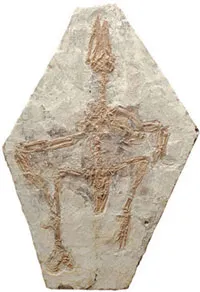
Lianhai Hou and Zhonghe Zhou, two paleontologists at the Chinese Institute of Vertebrate Paleontology, discovered a new bird fossil in 1995, and named it Confuciusornis. This fossil is almost the same age as Archæopteryx (around 140 million years), but has no teeth in its mouth. In addition, its beak and feathers shared the same features as today's birds. Confuciusornis has the same skeletal structure as present-day birds, but also has claws on its wings, just like Archæopteryx. Another structure peculiar to birds called the "pygostyle", which supports the tail feathers, was also found in Confuciusornis. In short, this fossil-which is the same age as Archæopteryx, which was previously thought to be the earliest bird and was accepted as a semi-reptile-looks very much like a bird living today. This fact has invalidated all the evolutionist theses claiming Archæopteryx to be the primitive ancestor of all birds.52
Another fossil unearthed in China, caused even greater confusion. In November 1996, the existence of a 130-million-year-old bird named Liaoningorniswas announced in Science by L. Hou, L. D. Martin, and Alan Feduccia. Liaoningornis had a breastbone to which the muscles for flight were attached, just as in today’s birds. This bird was indistinguishable from present-day birds also in other respects, too. The only difference was the teeth in its mouth. This showed that birds with teeth did not possess the primitive structure alleged by evolutionists.53
This was stated in an article in Discover "Whence came the birds? This fossil suggests that it was not from dinosaur stock".54
Another fossil that refuted the evolutionist claims regarding Archæopteryx was Eoalulavis. The wing structure of Eoalulavis, which was said to be some 25 to 30 million years younger than Archæopteryx, was also observed in today’s slow-flying birds. This proved that 120 million years ago, there were birds indistinguishable from birds of today in many respects flying in the skies.55
These facts once more indicate for certain that neither Archæopteryx nor other ancient birds similar to it were transitional forms. The fossils do not indicate that different bird species evolved from each other. On the contrary, the fossil record proves that today's birds and some archaic birds such as Archæopteryx actually lived together at the same time. Some of these bird species, such as Archæopteryx and Confuciusornis, have become extinct, and only some of the species that once existed have been able to survive down to the present day.
In brief, several features of Archæopteryx indicate that this creature was not a transitional form. The overall anatomy of Archæopteryx imply stasis, not evolution. Paleontologist Robert Carroll has to admit that:
The geometry of the flight feathers of Archæopteryx is identical with that of modern flying birds, whereas nonflying birds have symmetrical feathers. The way in which the feathers are arranged on the wing also falls within the range of modern birds… According to Van Tyne and Berger, the relative size and shape of the wing of Archæopteryx are similar to that of birds that move through restricted openings in vegetation, such as gallinaceous birds, doves, woodcocks, woodpeckers, and most passerine birds… The flight feathers have been in stasis for at least 150 million years…56
On the other hand, the "temporal paradox" is one of the facts that deal the fatal blow to the evolutionist allegations about Archæopteryx. In his book Icons of Evolution, Jonathan Wells remarks that Archæopteryx has been turned into an "icon" of the theory of evolution, whereas evidence clearly shows that this creature is not the primitive ancestor of birds. According to Wells, one of the indications of this is that theropod dinosaurs—the alleged ancestors of Archæopteryx—are actually younger than Archæopteryx:
Two-legged reptiles that ran along the ground, and had other features one might expect in an ancestor of Archæopteryx, appear later.57