

Reading time: ~5 min read
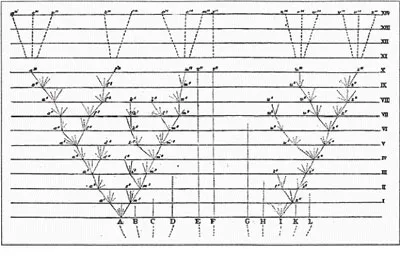
Darwinism maintains that life emerged from a single common ancestor and branched out by way of small changes. That being so, life must first have appeared in simple forms, all very similar. According to this same claim, the way that organisms grew different from one another, increasing in complexity, must have taken place over long periods of time. Therefore, according to Darwinism, life must have grown like a tree, starting from a single root and then spreading into various branches.
Indeed, this hypothesis is stressed in Darwinist sources, where the term “tree of life” is frequently employed. According to this metaphor, there must have been just one phylum initially, because the first imaginary cell also constituted the first basic body plan of life, or phylum. This hypothetical first species must later—and over an infinitely long period of time—have branched out into others.
The farther the new forms departed from their illusory evolutionary ancestors, the greater the differences in their appearances must have been. There must also have been a gradual increase in the number of phyla comprising these species.
Darwin depicted this imaginary tree of life in his The Origin of Species. He claimed that species (A) in the diagram branched out, like a tree, over a long period he divided into 14 time frames, and that differences between varieties would increase over the course of time. As an amateur biologist, Charles Darwin expressed his flights of fantasy on this subject: “I see no reason to limit the process of modification, as now explained, to the formation of genera alone... These two groups of genera will thus form two distinct families, or orders.”.157
Darwin’s unrealistic expectation imposes certain conditions: According to him, first of all species must have diverged, followed by the emergence of higher taxa and eventually, phyla. Therefore, the number of phyla should increase with time. Therefore, taxa should follow a “bottom-up” course in their appearance in the fossil record. If we think of the tree of life as a cone, then the course of biological variation over time should be one of “increasing diversity.” Therefore, the cone of diversity should assume a V shape. However, the fossil record shows that these expectations of Darwinism are fundamentally incorrect:
Refutation of Darwin No. 1: Taxa follow a top-down course in the fossil record, not a bottom-up one. And phyla emerged first!
The fact revealed by the fossil record is that first phyla came into being, followed by the emergence of lower taxa such as species.
The conclusions drawn by the researchers Douglas H. Erwin, James W. Valentine and J. J. Sepkowski from their comparison of the variation in life confirm this:
The fossil record suggests that the major pulse of diversification of phyla occurs before that of classes, classes before that of orders, orders before that of families. . . the higher taxa do not seem to have diverged through an accumulation of lower taxa.158
By claiming that lower taxa, such as classes and families, would diverge and vary over time and that species varied from a single phylum would in turn give rise to other phyla, Darwin assumed a “bottom-up” development.
Yet the Cambrian explosion reveals the exact opposite, as described by the science writer Roger Lewin:
Several possible patterns exist for the establishment of higher taxa, the two most obvious of which are the bottom-up and the top-down approaches. In the first, evolutionary novelties emerge, bit by bit... The Cambrian explosion appears to conform to the second pattern, the top-down effect.159
The course of appearance of taxa in the fossil record is top-down. Moreover, the number of phyla, which should increase by stages over long periods of time, actually reduces. Fifty different phyla appeared in the Cambrian, but today there are only around 35. (See “The Fossils Are Examined” section earlier in this book.) Darwin’s assumptions have been literally overturned in the face of the fossil record, and paleontology has definitely and clearly invalidated his theory.
Refutation of Darwinism No. 2: The cone of diversity is the exact opposite of what Darwin claimed.
While branching the tree of life, Darwin hypothesized that life would diversify in the form of a cone of increasing diversity. Yet life does not increasingly expand and diversify; on the contrary, it began with great variety and then narrowed.
Philip Johnson, a professor at the University of California at Berkeley, describes the contradiction between Darwinism and this fact revealed by paleontology:
Darwinian theory predicts a “cone of increasing diversity,” as the first living organism, or first animal species, gradually and continually diversified to create the higher levels of taxonomic order. The animal fossil record more resembles such a cone turned upside down, with the phyla present at the start and thereafter decreasing.160
Darwin has thus been refuted. The variety assumed by Darwin to be a cone shaped “V” is now in the form of a line “_”.
The fact that Darwin’s famous tree of life is actually a falsehood is a major disappointment for the theory itself and for its proponents. In his book Icons of Evolution, the American biologist Jonathan Wells describes this fact:
Since higher levels of the biological hierarchy appear first, one could even say that the Cambrian explosion stands Darwin’s tree of life on its head. If any botanical analogy were appropriate, it would be a lawn rather than a tree. Nevertheless, evolutionary biologists have been reluctant to abandon Darwin’s theory. Many of them discount the Cambrian fossil evidence instead.161
Life appeared suddenly, and with a great variety, with the Cambrian explosion. Clearly there was no process of evolution, beginning with a single bacterium and extending eventually as far as human beings, of the sort Darwinists still believe in. Darwin’s tree of life has been chopped down in a single moment.