

Reading time: ~5 min read
When terrestrial strata and the fossil record are examined, it is to be seen that all living organisms appeared simultaneously. The oldest stratum of the earth in which fossils of living creatures have been found is that of the Cambrian, which has an estimated age of 500-550 million years.
The living creatures found in the strata belonging to the Cambrian period emerged all of a sudden in the fossil record-there are no pre-existing ancestors. The fossils found in Cambrian rocks belonged to snails, trilobites, sponges, earthworms, jellyfish, sea hedgehogs, and other complex invertebrates. This wide mosaic of living organisms made up of such a great number of complex creatures emerged so suddenly that this miraculous event is referred to as the "Cambrian Explosion" in geological literature.
Most of the creatures in this layer have complex systems have complex systems and advanced structures, such as eyes, gills, and circulatory systems, exactly the same as those in present-day specimens. For instance, the double-lensed, combed eye structure of trilobites is a wonder of creation. David Raup, a professor of geology in Harvard, Rochester, and Chicago Universities, says: "the trilobites 450 million years ago used an optimal design which would require a well trained and imaginative optical engineer to develop today".30
These complex invertebrates emerged suddenly and completely without having any link or any transitional form between them and the unicellular organisms, which were the only life forms on earth prior to them.
Richard Monastersky, a science journalist at Science News, one of the popular publications of evolutionist literature, states the following about the "Cambrian Explosion", which is a deathtrap for evolutionary theory:
A half-billion years ago, the remarkably complex forms of animals we see today suddenly appeared. This moment, right at the start of Earth's Cambrian Period, some 550 million years ago, marks the evolutionary explosion that filled the seas with the earth's first complex creatures. ...the large animal phyla of today were present already in the early Cambrian ...and they were as distinct from each other as they are today.31
Deeper investigation into the Cambrian Explosion shows what a great dilemma it creates for the theory of evolution. Recent findings indicate that almost all phyla, the most basic animal divisions, emerged abruptly in the Cambrian period. An article published in Science magazine in 2001 says: "The beginning of the Cambrian period, some 545 million years ago, saw the sudden appearance in the fossil record of almost all the main types of animals (phyla) that still dominate the biota today".30 The same article notes that for such complex and distinct living groups to be explained according to the theory of evolution, very rich fossil beds showing a gradual developmental process should have been found, but this has not yet proved possible:
This differential evolution and dispersal, too, must have required a previous history of the group for which there is no fossil record.32
How the earth came to overflow with such a great number of animal species all of a sudden, and how these distinct types of species with no common ancestors could have emerged, is a question that remains unanswered by evolutionists. The Oxford University zoologist Richard Dawkins, one of the foremost advocates of evolutionist thought in the world, comments on this reality that undermines the very foundation of all the arguments he has been defending:
For example the Cambrian strata of rocks... are the oldest ones in which we find most of the major invertebrate groups. And we find many of them already in an advanced state of evolution, the very first time they appear. It is as though they were just planted there, without any evolutionary history.33
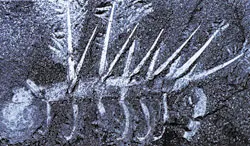
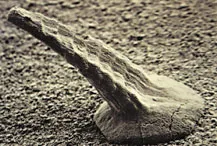
As Dawkins is forced to acknowledge, the Cambrian Explosion is strong evidence for creation, because creation is the only way to explain the fully-formed emergence of life on earth. Douglas Futuyma, a prominent evolutionist biologist admits this fact: "Organisms either appeared on the earth fully developed or they did not. If they did not, they must have developed from pre-existing species by some process of modification. If they did appear in a fully developed state, they must indeed have been created by some omnipotent intelligence." 34
Darwin himself recognised the possibility of this when he wrote: "If numerous species, belonging to the same genera or families, have really started into life all at once, the fact would be fatal to the theory of descent with slow modification through natural selection."35Period is nothing more or less than Darwin's "fatal stroke". This is why the Swedish evolutionist paleoanthropologist Stefan Bengtson, who confesses the lack of transitional links while describing the Cambrian Age, makes the following comment: "Baffling (and embarrasing) to Darwin, this event still dazzles us".36
Obviously, the fossil record indicates that living things did not evolve from primitive to the advanced forms, but instead emerged all of a sudden and in a perfect state. In short, living beings did not come into existence by evolution, they were created.