

Reading time: ~8 min read
The importance of the perfection and order inside the DNA molecule is revealed by genetic diseases. A single molecule's error could damage, or even kill, the human being concerned. But these molecules clearly behave at the command of a superior intellect and almost never make any errors in the work they do. The 100 trillion DNA molecules in your body, the nucleotides that constitute that DNA, the proteins that build the cell, the enzymes that so perfectly organize the traffic among those cells, the amino acids that make up the enzymes, and the 100 trillion cells that contain that DNA and make you, all are structures with a sublime organization and order.
Bear in mind the delicate order and balance in the information contained in DNA, and you can better see how impossible the idea of chance emergence truly is. As we have already shown in some detail, DNA's information is made up by the "letters" A, T, G and C laid out one after the other in a particular and meaningful way. In this sequence, however, there must not be a single mistake. In a whole encyclopedia, a spelling error or wrong letter may not be that important and may usually not even be noted. In contrast, a single error in any step in DNA –say, the faulty coding of letter number 1 billion, 719 million, 348 thousand and 632– could have lethal consequences for the cell, and therefore for the entire human being.
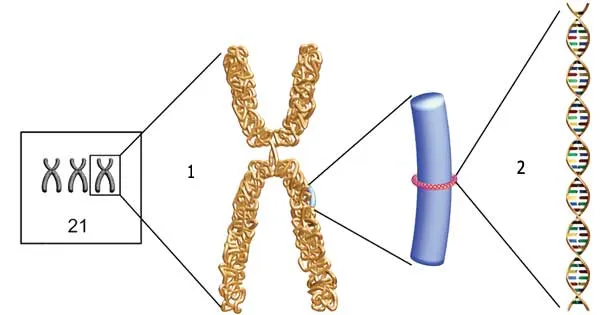
The minimum change in a genome creates a change in a nucleotide. Yet even here, a seemingly insignificant error can give rise to very serious consequences. The presence of A (adenine) instead of C (cytosine) in the pigment-coding gene known as rhodopsin in the human retina causes a disease leading to blindness.116
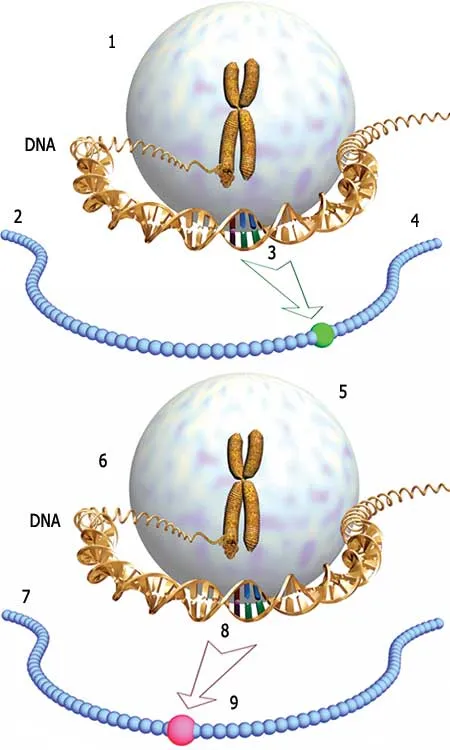
Inherited diseases that are almost impossible to treat can emerge as the result of an impairment arising in a single gene. Children born with the disease phenylketonuria, for instance, are unable to metabolize the amino acid phenylalanine, found in protein foods. As a result, the increasing phenylalanine and its waste products in the blood and other body fluids damages the growing child's brain, leading to serious mental impairment and various diseases of the nervous system. This disease is caused by a defective gene responsible for the manufacture of the enzyme hydroxylase. Gene defects of this kind are the causes of other diseases such as Mediterranean anemia, hemophilia, cystic fibrosis, familial Mediterranean fever (FMF) and congenital deafness.
Many other inherited diseases that give rise to very serious consequences are caused by various defects in genetic structure. The main reason for every one of these disorders is just a few of the billions of letters in the genetic code being in the wrong place.
In the genetic disease known as Huntington's disease, patients appear healthy up until the age of 35. After that age, however, uncontrollable contractions suddenly take place in the arms, leg and face muscles. Since this fatal and incurable disease also affects the brain, the sufferer's memory and mental functions grow increasingly weaker. All these diseases demonstrate that the genetic code has been balanced so flawlessly that the slightest alteration in the system can cause serious problems. Just one letter too few or too many can give rise to fatal diseases or serious handicaps that last throughout the sufferer's life. Therefore, it's impossible to claim that such a delicate order and regularity came about by chance and--as maintained by the theory of evolution--developed spontaneously through mutations.
That being so, how did the magnificent information contained in DNA come about? How was it coded? Evolutionists, who trace the origins of life to chance, have no answer to give. Those who claim that billions of pieces of data, were written by chance will of course have no answer to give. In the same way that a book has an author, so the information in DNA has a creator; and that Creator is our Lord, Almighty and Omniscient Allah.
Random effects only damage living things, because of the way the genetic code is encoded. Just about all known genes contain more than one piece of information about the organism. The molecular biologist Michael Denton describes this property of genes:
The effects of genes on development are often surprisingly diverse. In the house mouse, nearly every coat-colour gene has some effect on body size. Out of seventeen x-ray induced eye colour mutations in the fruit fly Drosophila melanogaster, fourteen affected the shape of the sex organs of the female, a characteristic that one would have thought was quite unrelated to eye colour. Almost every gene that has been studied in higher organisms has been found to effect more than one organ system. . . .117
Because of this feature in the genetic structure, any random change in any gene in the DNA will impact on more than one specific organ. The impairment will have wide-ranging destructive effects.
In short, health cannot emerge by chance. On the contrary, it is a blessing from our Lord, the Compassionate and Merciful, the result of a sublime creation. Allah shows us, with examples, that He can take back this blessing whenever He so chooses and can create a lethal disease in an unknown part of the body.
There is, of course, great wisdom behind these deficiencies. People need to give thanks to Allah, Who bestows their health upon them and "formed them as a man" (Surat al-Kahf, 37). When they fall ill, they must be aware that both health and sickness derive from Him and beg for help, as did the Prophet Abraham (pbuh). As he put it, "and when I am ill, it is He Who heals me."(Surat ash-Shu'ara, 80)
Footnotes
99. Phillip E. Johnson, The Wedge of Truth: Splitting the Foundations of Naturalism, InterVarsity Press, USA, p. 134.
100. Gerald L. Schroeder, The Hidden Face of God, pp. 79-80.
101. A. E. Wilder-Smith, The Natural Sciences: Know Nothing of Evolution, T. W. F. T. Publishers, ABD, p. 82.
102. Gerald L. Schroeder, The Hidden Face of God, p. 49.
103. David S. Goodsell, Our Molecular Nature, p. 37.
104. Geraldine Lux Flanagan, Beginning Life, Dorling Kindersley, London, 1996, p. 42.
105. Gerald L. Schroeder, The Hidden Face of God, p. 112.
106. Ibid.
107. Ibid.
108. Nicholas Wade, "How Cells Unwind Tangled Skein of Life", The New York Times, October 21, 1997, Tuesday, s. F1.
109. Geraldine Lux Flanagan, Beginning Life, p. 43.
110. Lee M. Spetner, Not By Chance, Shattering The Modern Theory of Evolution, p. 234.
111. Ali Demirsoy, Kalıtım ve Evrim (Heritage and Evolution), Meteksan Publishing, Ankara, 1984, p.158.
112. The Incredible Machine, National Geographic Society, s. 29.
113. Lee M. Spetner, Not By Chance, Shattering The Modern Theory of Evolution, The Judaica Press Inc., 1997, ss. 233-234.
114. The Incredible Machine, National Geographic Society, p. 29.
115. Gerald L. Schroeder, The Hidden Face of God, p. 72.
116. Lee M. Spetner, Not By Chance, Shattering The Modern Theory of Evolution, p. 45.
117. Michael Denton, Evolution: A Theory in Crisis, Adler&Adler, Publishers, Inc. ABD, 1986 p. 149.