Cyanobacteria Fossils: An Insoluble Dilemma For Evolutionists
Reading time: ~7 min read
Rock strata in the Apex Chert region of Australia contain cyanobacteria fossils, or stromatolites (stromatoliths), dating back 3.9 billion years.
Stromatolites form in shallow water with the accumulation and freezing of the sediment of micro-organisms such as cyanobacteria. Stromatolites began forming in the Precambrian Period and are formed by calcium carbonate particles (limestone) carried by the sea adhering to the filaments formed by blue-green algae.2 These structures are rich in chlorophyll. Over the geological ages they formed in globes or domes of various sized immediately beneath the surface of the sea.
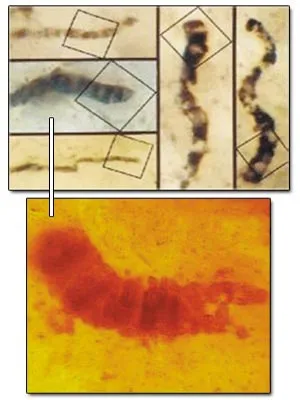
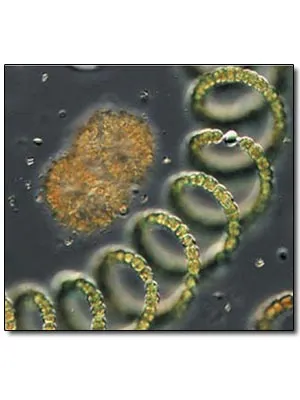
Human beings and animals possess no mechanism allowing them to make direct use of solar energy. That energy can only be obtained by being synthesized as a result of the process of photosynthesis performed by green plants and micro-organisms. Cyanobacteria species that make photosynthesis produce more than half the oxygen in the atmosphere. The energy that these organisms manufacture with solar energy is stored in the form of simple sugars. This sugar is needed for the biochemical reactions essential for the survival and growth of living things on Earth, and also for respiration.As well as oxygen and carbon dioxide, living things also need nitrogen (N2) in order to survive. Nitrogen represents one of the fundamental building blocks in the living body, especially in the structure of nucleic acids, proteins and vitamins. The Earth's atmosphere consists of approximately 78% nitrogen. However, despite their needing it, living things cannot absorb this nitrogen in the air into their bodies. This gas has to be converted in some way into a form that living things can make use of and then recycled back into the atmosphere if it is not to run out. That need is again met by microscopic bacteria.The living things that must first absorb nitrogen from the air are plants. Plants cannot use nitrogen in gas form. Nitrogen is converted by nitrite bacteria into nitrite, and nitrate bacteria then convert that nitrite into nitrate, a form that plants can use.In carrying out the nitrogen cycle, the bacteria that evolutionists describe as “simple” actually function like living chemical laboratories, as with photosynthesis, and have been performing complex chemical reactions, beyond the comprehension of anyone without a close knowledge of chemistry, since the day they were first created.Fossil remains of the world’s oldest micro-organism, dating back 3.9 billion years, have been found in Australia’s Apex Chert region. The cyanobacteria fossils at the top and left were discovered in Apex Chert and are 3.5 billion years old.One in every ten cells in the filamentlike cyanobacteria in the picture above is known as a heterocyst, and it is these cells, which are completely insulated from oxygen, that perform the task of fixing nitrogen.
Some of the characteristics of cyanobacteria, those marvelous micro-organisms, that refute the claim of the theory of evolution that life forms came into beings by chance, may be summarized as follows:
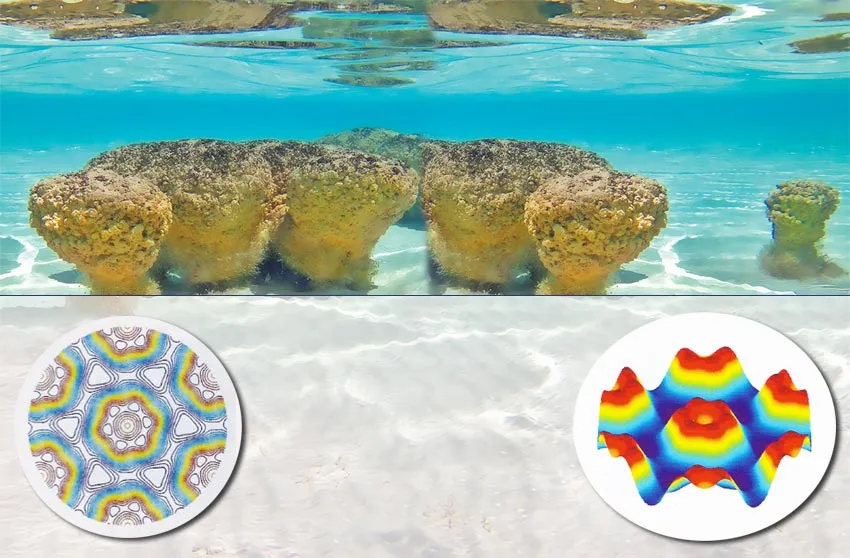
The picture above shows images of the hexagonal and symmetrical “S layer” in cyanobacteria from above and from the side.The theory of evolution has no meaningful answer to the highly esthetic appearance and symmetry in the architecture of these living things. It is impossible for this symmetry and flawless system to come about by chance.The flawlessness in these tiny organisms clearly shows the creation of our Almighty Lord, the sublime Creator.The stromatolite fossil record is exceedingly rich, and they have been around in various environments on Earth for some four billion years. They were initially discovered in Shark Bay, Australia in 1956. They are also found in the Bahamas, the Indian Ocean, Africa and the USA. Stromatolites have a bacteria population of 3 billion per square meter. When these combine with sediments and organic materials and gradually grow to 10 million times their own size, they build structures up to 1.5 meters (5 feet) in size. Since they grow very slowly, a one meter stromatolite will be around 2,000 years old.8
The giant activities of cyanobacteria, those marvelous micro-organisms:
• Cyanobacteria by themselves produce 30% of the Earth’s annual amount of oxygen3; that figure is equivalent to the amount produced by all the green plants on Earth.
• These bacteria are very small in size, but their production is enormous. There are more than 100 of them in a liter of water, and they account for 10% to 20% of the productivity of the oceans. Despite being invisible, they predominate over a large part of the Earth.
• This form of bacterium is capable of performing very different processes (such as photosynthesis, nitrogen fixation (the process whereby nitrogen is turned into a form usable by living things) and respiration, within a single cell. This requires a matchless cell membrane system, as outlined above. For example, the bacteria need an oxygen-free environment for nitrogen fixation, but an oxygen-rich environment for all the other processes, and these require very different cell membranes. This architecture makes cyanobacteria one of the most complex members of the bacterial kingdom.4
• In 1980, cyanobacteria were observed to possess a “circadian” clock.5 A circadian clock is the automatic regulation of the body according to its external environment, seen in multi-celled organisms. Cyanobacteria have been observed to engage in photosynthesis and respiration by absorbing oxygen into their cells for 12 hours a day, while they perform nitrogen fixation for the other 12 hours.
• Cyanobacteria are able to move in water without using flagellae (the bacterial whip). The secret behind the way these organisms can move without using any body part has still not been adequately explained, despite ongoing research for the last 20 years. The hexagonal layer known as the “S layer,” which makes up the most external layer of the cell, is three-dimensional and symmetrical. This layer is thought to play a role in cell movement. Because when the gene “swm6,” which expresses that symmetry, is subjected to mutation, the cell has been observed to be unable to move.6
• Cyanobacteria are capable of manufacturing anticarcinogenic, antiviral and UV-protective substances. These characteristics mean they are used in genetic studies intended to benefit human beings. For example, the antiviral protein Cyaniovirin-N produced by the Cyanobacterium species Nostoc ellipsosporum neutralizes the HIV virus. This protein possesses the ability to adhere to the oligosaccharide structures that enable the HIV virus to attach to the cells. Studies on this subject are still being planned.7
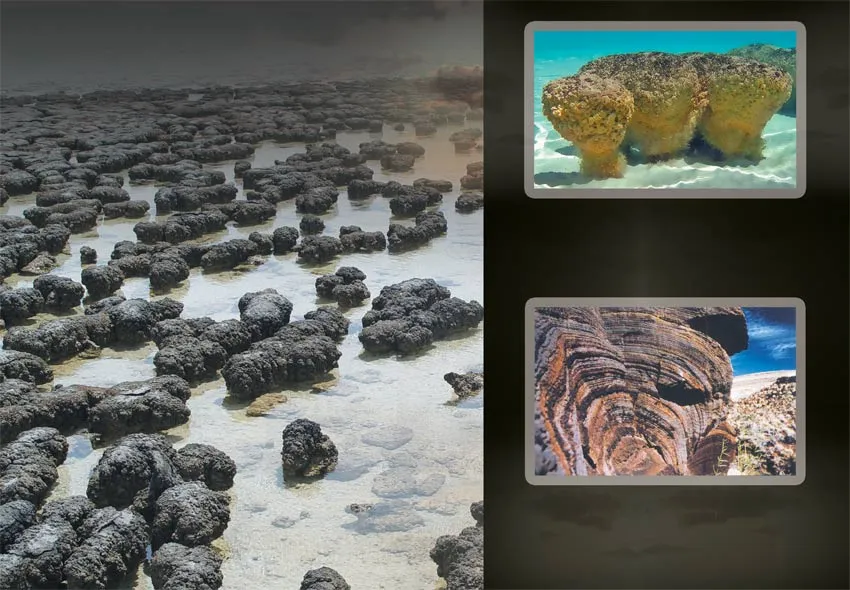
Bacteria are not only found in the seas or water sources. They are also agents present in all living things, from the human body to termites living underground to the root hairs on a plant. These organisms have spread everywhere on Earth and have been discharging their functions with the same perfection for billions of years. All this of course points to one single truth: Creation.The proponents of the theory of evolution are in fact perfectly well aware that these organisms are not simple at all. That is why they are in a constant state of difficulty and doubt when they try to describe the characteristics and mechanisms possessed by the perfect organisms in question. Evolution is an unscientific theory unable even to account for the existence of a micro-organism.The science and technology that have made such advances in the 21st century have revealed, under the scanning electron microscope, a brand new world that again refutes the theory of evolution. Yet another has been added to the increasingly lengthy list of questions for Darwinists about life on Earth. Every piece of research, every new finding, every characteristic we encounter in living things, is a means whereby we can discover the flawless artistry created by Allah in invisible things and whereby we can properly appreciate it.Bacterial strata gradually darken because of their sediments and move upward in order to reach the sunlight. As seen in the picture, one layer is added onto another and they eventually produce very large towers.These fossil stromatolites in the Pilbara region of Australia date back to the Precambrian Era. The gray, convoluted layers show how stromatolites grow upward.The stromatolites on this page have been living in the Hamelin Pool Basin of Shark Bay, Australia for 4,000 years.Stromatolite fossils dating back 3.9 billion years can be found in other regions of Australia. There is absolutely no difference between these 3.9-billion-year-old fossil stromatolites and those living today. These organisms have never evolved.