

Reading time: ~5 min read
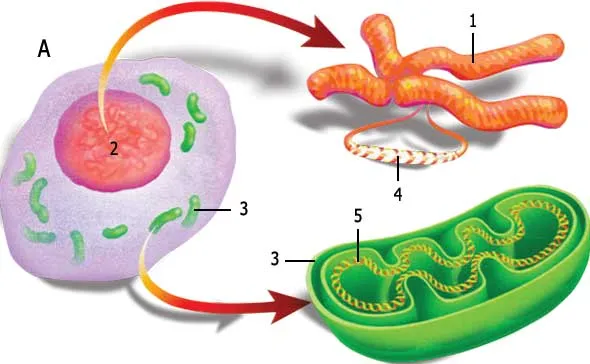
The mitochondria consisting of protein inside the cell produce the energy needed by the cell. In these plants, chemical energy obtained from foodstuffs is converted into energy packets known as ATPs which the cell can use. All the events permitting life inside the cell take place thanks to these ready-to-use energy packets. In addition to being present in the cell nucleus, DNA is also found in these energy-producing mitochondria.
Mitochondria contain mitochondrial DNA (mtDNA). Evolutionists interpret the inherited variation in mitochondrial DNA as a form of evolution and combine that hypothesis with another which they refer to as the "molecular clock." This hypothesis, launched in 1965, suggested that regular changes would take place in the nucleotide and protein sequences. On that basis, it was further assumed that living things could be analyzed in terms of mtDNA changes to determine at what time they separated from a common ancestor.
However, it is unclear what kind of clock mechanism in mtDNA can bring about regular changes in living things. Fossilized bones cannot harbor DNA molecules, since these decay very quickly. Therefore, there can be no question on investigating natural history on the basis of the DNA molecule. These analyses are evolutionists' efforts to force the history of life to square with their own hypotheses.
Based on that preconception, evolutionists tried to establish when and where the human family tree began. Since the widest variety of mitochondrial DNA was observed in Africans, they decided that these must be the oldest "branch" of family tree and claimed that all human races living today were descended from a woman who lived in Africa 130,000 years ago, and that she had appeared by way of evolution as the first representative of Homo sapiens.
Since the estimates regarding this woman were based on mitochondrial DNA analyses, she is known as the "mitochondrial Eve." But when examined with an unbiased scientific eye, the method employed in this research can easily be seen as incapable of determining either the dating or geographical location of the earliest humans. Evolutionists rely on claims and hypotheses that cannot be proven, nor documented with experiment and observation. Indeed, many scientists who support the theory of evolution admit that this thesis has no scientific value.
Henry Gee, a member of the editorial board of Nature magazine, described the results of mitochondrial DNA research as "garbage" in an article titled "Statistical Cloud over African Eden."161 In his article dealing with 136 existing mtDNA series, Gee reported that the number of family trees drawn up exceeded 1 billion. In other words, around 1 billion alternative family trees were ignored in this research, and only the single tree was chosen that matched the hypothesis of a supposed evolutionary transition between chimpanzees and human beings.
First off, none of these hypotheses constitute any scientific evidence for the theory of evolution. For example, any evolutionist claiming, on the basis of molecular clock analysis, that humans and chimpanzees separated from one another 10 million years ago has already started out assuming an evolutionary relationship between these two species. Such people are thinking in a logical vicious circle. Studies of this kind, built on such assumptions, are a waste of time.
The Washington University geneticist Alan Templeton states that it is impossible to determine a date for the origin of humanity on the basis of DNA series, because strains of DNA have become exceedingly mixed up among human communities.162 Viewed in mathematical terms, this makes it impossible to distinguish the mtDNA belonging to any single human in the family tree. The most striking admission came from the authors of the thesis themselves. Mark Stoneking from Pennsylvania State University, who repeated the study in 1992, admitted in a letter to Science magazine that the "African Eve" thesis was invalid. 163
In addition, mitochondrial DNA analyses were performed on the assumption that mitochondria are passed on only by the mother, and that changes in mitochondrial DNA components can thus be traced back though the matriarchal line, right back to the very earliest ancestor. But in fact, the idea that mitochondria are passed on only by females is now no more than a myth, because scientific discoveries have shown that mitochondria can also be handed down from the father. "Mitochondria can be inherited from both parents," a report in New Scientist magazine, described how Danish patients had received around 90% of their mitochondria from their fathers. This meant that all mtDNA studies supporting evolutionary scenarios were completely meaningless. This state of affairs is described in New Scientist magazine:
Evolutionary biologists often date the divergence of species by the differences in genetic sequences in mitochondrial DNA. Even if paternal DNA is inherited very rarely, it could invalidate many of their findings.164
Despite being a well-known evolutionist publication, the magazine Nature admitted that these findings disproved the hypotheses of mitochondrial DNA:
The assumption that mitochondrial DNA . . . is inherited purely through the maternal line is a lynchpin of studies tracking human evolutionary history and the movements of human populations in the prehistoric past.165
Finally, an article in the journal Annals of Human Genetics reported that more than half of all the mitochondrial DNA analyses published to date had been found to be flawed.166 According to the report, the mitochondrial DNA data banks used by evolutionists were based on incorrectly processed data. This state of affairs, revealed by the researcher Peter Forster, was reported in Nature magazine:
The mistakes may be so extensive that geneticists could be drawing incorrect conclusions in studies of human populations. . .167
This analysis of Forster's further confirmed the unreliable nature of the statistical data used by evolutionists in their studies. As you've seen, genetic analysis that examine the genes of human beings living today are carried out using flawed methodology and interpreted solely in the light of evolutionist preconceptions. Concrete scientific findings proving the invalidity of mitochondrial DNA analyses refute evolutionist claims. Since no evolutionary process ever actually took place, everyone constructs his own personal scenario, and the mitochondrial Eve thesis is just one of those endeavors to prop up the theory of evolution-which is about to be consigned to history because of the heavy blows it's been dealt.
References
- Henry Gee, "Statistical Cloud over African Eden", Nature, 13 Februaryt 1992, Vol. 355, p. 583. ↩
- Marcia Barinaga, "'African Eve' Backers Beat a Retreat", Science, 7 February 1992, Vol. 255, p. 687. ↩
- S. Blair Hedges, Sudhir Kumar, Koichiro Tamura, Mark Stoneking, "Human Origins and Analysis of Mitochondrial DNA Sequences", Science, 7 February 1992, Vol. 255, pp. 737-739. ↩
- Danny Penman, "Mitochondria Can Be Inherited From Both Parents", New Scientist, 23 August 2002; http://www.newscientist.com/news/news.jsp?id=ns99992716 ↩
- Eleanor Lawrence, "Fathers Can Be Influential Too", 18 March 1999: http://www.nature.com/nsu/ 990318/990318-5.html ↩
- P.M. Forster, "To Err is Human", Annals of Human Genetics, January 2003, Vol. 67, no. 1. pp. 2-4. ↩
- Carina Dennis, "Error Reports Threaten to Unravel Databases of Mitochondrial DNA", Nature, 20 February 2003, Vol. 421, pp. 773-774. ↩