

Reading time: ~8 min read
Proteins are large, complex molecules that perform a great many essential tasks in the body. The proteins that carry out most of the processes in the cell are essential to the formation of the body's tissues and organs and to those organs' ability to do their own jobs. Proteins consist of hundreds or even thousands of smaller units known as amino acids. Twenty different kinds of amino acid are used to give rise to one protein, and every protein consists of a combination of between three hundred and over a thousand amino acids.73 The arrangement of the amino acids determines proteins' unique three-dimensional structures and functions. Thus every organ uses these proteins specially manufactured for it and operates the systems that keep the individual alive.
Inside the human body there are around 200,000 different types of protein, each with its own individual importance. Were the 20 amino acids that comprise proteins to combine together haphazardly, the result would be masses of amino acids in various functionless sequences. Yet these very special arrangements permit proteins to come into existence, essential to human beings' vital functions. Depending on their own particular sequences, proteins are building blocks in the various regions of the body and assume responsibility for different tasks. For example, proteins compose the enzymes that combine to accelerate processes in the body, antibodies that fight disease, and hormones that regulate the functioning of the organs. Each one of these has its own individual, essential importance for the body.
Proteins absorbed in food do not work in the body in their existing form. They are first taken into special laboratories in the cell and broken down into smaller molecules- amino acids. Then, these amino acids are recombined in different sequences to constitute whichever of the 200,000 kinds of proteins encoded in DNA is required at any given time. This mechanism, every stage of which is a miracle in its own right, is known as protein synthesis.
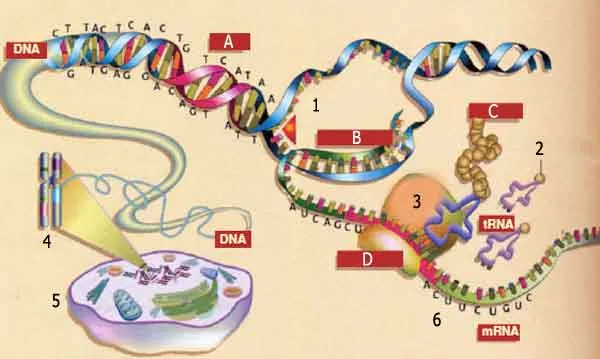
Protein synthesis is the main job of the cells, because proteins carry out just about all the work inside cells. Tens of thousands of different kinds of proteins in the human body are repaired when required and replaced with new ones when they grow old. Blueprints inside the genetic information are noted for the production of a new protein, and the required variety is duly manufactured. The production plan for each protein exists in detailed instructions encoded into DNA.
The molecular biologist Michael Denton refers to the protein production blueprint: Where DNA is the data bank of life, the ultimate repository of all biological information, the proteins are life's animated actors, the universal constructor devices, the nanomanipulators which translate the one-dimensional DNA dream into the vital three-dimensional reality of the cell. By reading and following the instructions in the DNA, the proteins manipulate the atoms and molecules of life into the trillions of unique and specific conformations upon which the miracle of self-replication and self-assembly depends. 74
As an individual goes through daily life, just about all the 100 trillion or so cells in the body are carrying out complex processes at every moment. All cells, apart from reproductive and blood cells, produce around 2,000 proteins a second. The approximately 100 trillion cells in an adult human body flawlessly organize some 150,000,000,000,000,000,000 (150 quintillion) amino acids to give rise to protein chains.75 This process goes on every day, every minute, every second. Prof. Gerald L. Schroeder describes this environment inside the cell:
Our cells are a nonstop marvel. Transport in all directions satisfies the needs for the two thousand proteins manufactured every second of every day, seven days a week. No night-time snooze . . . here.76
The system for the flawless production of proteins, so vitally important to the survival of living things, is incomparably more complex and organized than any Earthly analogy that could be cited. In this complex production plant, there is no room for the slightest error. Any disruption at any stage is immediately put right by the security system, ensuring that the proteins that permit the organism to remain alive are produced with no disruption, at exactly the right time, and in exactly the right place and form.
Another miraculous aspect of protein production is that it occurs at very high speeds. A protein molecule carrying 100 amino acids, for instance, is synthesized by the E. coli bacterium cell in five seconds.77 No factory on Earth is able to complete its entire production process, in a flawless manner, at such a speed. This speed is very important, because several proteins are needed in the cells at any time in order for the organism to survive. In his book The Machinery of Life, the molecular biologist David S. Goodsell expresses the importance to life of protein synthesis:
The key molecular process that makes modern life possible is protein synthesis, since proteins are used in nearly every aspect of living. The synthesis of proteins requires a tightly integrated sequence reactions most of which are themselves performed by proteins. Thus posing one of the unanswered riddles of biochemistry: which came first, protein or protein synthesis? If proteins are needed to make proteins, how did the whole thing get started? 78
It is impossible for evolutionists to answer this question, because their Darwinist preconceptions prevent them seeing the facts- or rather, prevents them from openly stating them. The fact is, however, that the fact of creation is inescapable: it is Almighty Allah Who simultaneously creates proteins and the protein synthesis that takes place at great speed inside the cell. Using the coded information in the DNA as a vehicle, our Lord has permitted such vital processes as protein synthesis to continue without interruption.
During protein production, many proteins work at the same time. All the required components work flawlessly together inside the cell. More than 80 ribosome proteins, a messenger molecule with more than 20 amino acids, more than a dozen helper enzymes, more than 100 enzymes that carry out the final processes, and 300 macromolecules, more than 40 of them being RNA molecules- all play co-coordinated roles in protein synthesis.79 A large engineering team would have difficulty co-coordinating this impeccable production system. Yet it takes place in a space no larger than 1/1000 millimeter, and the intense activity of hundreds of much smaller molecules permits life to continue. The absence of just one of the molecules involved in the production will disrupt the entire chain. A system that functions in such a planned way and with such evident consciousness is possible only through creation by Allah, the absolute Lord of all things.
This chapter will describe only the general lines of the process as we show how use is made of the information in DNA.
Protein synthesis is carried out in two stages, known as transcription and translation, which permit the information in DNA to be transmitted to RNA, and from there to the proteins.
Transcription, the first step, begins in the cell nucleus. The genetic information in the double strip of DNA is to be transported by means of the single-strip RNA molecule.
Translation, the final step in protein synthesis, takes place in the cell cytoplasm outside the nucleus, where of the genetic information in RNA is transmitted to new proteins.
Let's now look at the general outlines of these stages: