

Reading time: ~12 min read
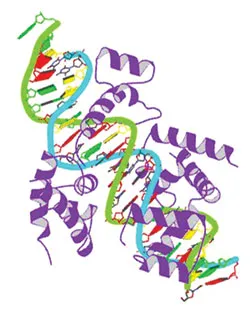
So-called Hox genes, a particular subgroup of homeobox genes, are a group of genes shared by a number of animal groups. What distinguishes these from other genes is their central task in regulating the body development. Hox genes are managers that control the development of all life, from a fertilized egg cell to maturity, instructing the genes that will construct a particular organ when and where to go into action. For example, the cells that will comprise the spinal cord settle in the region of the back from the moment the embryo first forms. The cells that constitute the eye take their place in the cranial section. This order or placement is encoded in the Hox genes. Instructions issued by the Hox genes are forwarded to an initiator protein with a sequence of 60 amino acids, again produced by Hox genes. This protein binds to and activates the relevant genes. However, Hox genes contain no information about any given organ, the eye for instance. They are merely charged with switching the genes that do bear these data on or off. In short, Hox genes are like buttons that activate or deactivate the gene group concerned with a particular production. For example, the body plan, appearance and development of mammals are controlled by some forty Hox genes.145
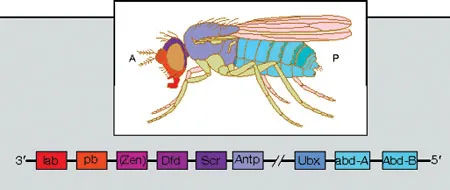
One important feature of Hox genes is that they line up on the chromosome in the same sequence as the regions with which they are concerned. For example, if we examine a fly, we see that its body consists of a number of sections: its head, thorax, and abdomen. The first gene in the fly’s Hox gene series is the one that regulates the development of the head. The next one regulates the development of the thorax, and so forth.
When scientists discovered this arrangement, they wondered if they tampered with the sequence of Hox genes in organisms, what the effects would be. To that end, they carried out a number of experimental mutations. Changing the position of these genes in Drosophila fruit flies led to the emergence of monstrous insects, such as those with legs emerging from their heads.146
These results make it clear how complex the genetic codes in living things are, and that any random changes to that complexity will have inevitably harmful effects. The idea that Hox mutations could cause living things to evolve into other species was thus shown to be illusory.
Dr. Christian Schwabe from the Department of Biochemistry and Molecular Biology, Medical University of South Carolina describes these results:
Control genes like homeotic genes may be the target of mutations that would conceivably change phenotypes*, but one must remember that, the more central one makes changes in a complex system, the more severe the peripheral consequences become. . . . Homeotic changes induced in Drosophila [fruitfly] genes have led only to monstrosities, and most experimenters do not expect to see a bee arise from their Drosophila constructs.147As you have seen, the development of any living thing is an exceedingly complex process. The Hox genes that regulate such processes definitively refute scenarios based on random change. Even so, some evolutionists still ignore this scientifically demonstrated fact and continue to defend evolutionary scenarios concerning Hox genes. James Valentine of University of California at Berkeley, David Jablonski from University of Chicago and Douglas Erwin of the National Museum of Natural History in Washington D.C. relate Hox genes to the sudden emergence of Cambrian life forms, suggesting that many phyla that arose in that period differentiated from another as a result of mutations taking place in these Hox genes. In order to protect their scenario from the known harmful effects of Hox mutations, they resort to the entirely artificial claim, based on no scientific observation, that the Hox genes at that time were highly flexible and permitted change.
Simon Conway-Morris of Cambridge University says that this hypothetical “flexibility” rests on no scientific grounds:
Just as spoken language (also modular) is flexible enough to support the whole of human culture, says Valentine, this genetic language is so basic, so powerful, and so adaptable that it could underlie the whole amazing diversity of animal life.
Sounds great, but making bold claims is the easy bit—to convince your colleagues, you usually need some evidence. Valentine, Jablonski and Erwin needed to show that these mapmaking genes actually existed in the Cambrian. That posed a problem— . . . genes don’t fossilise, least of all for half a billion years and more.148
. Raymond G. Bohlin, a zoologist and molecular biologist, describes the unscientific aspect of the assumption regarding Hox genes in the Cambrian:
Some evolutionists have gone so far as to suggest that the mechanisms of evolution operating in the Cambrian were probably radically different from what has taken place ever since. This raises the possibility that we may never be able to study these mechanisms because animals with the proper genetic structure no longer exist. We are left only with the products of the Cambrian explosion and none of the precursors. The speculations will therefore be wild and uncontrollable since there will be no way to test these theories. Fossils leave no trace of their genetic organization.149
These genes control structures that have already been encoded. These genes cannot code for a new structure and cannot endow an organism with any new organ that does not already exist. They don’t produce new genetic information for the development of structures. They are merely regulators. They use the information given to them, and organize it in such a way—by the will and with the permission of Allah—to establish an order within the body. Therefore, they cannot be the cause of the emergence of new information, new structures and new organs needed for a completely different life form.
Dr. Paul Chien, chairman of the Department of Biology at the University of San Francisco, who discovered the Cambrian fauna in the Chinese Chengjiang formation and carried out lengthy research into them, has this to say:
There are other theories, too, like that of Berkeley professor James Valentine . . . In developmental biology, the study of embryo development, there’s been a big discovery of something called Hox genes. They are regulatory genes, and they turn on and off sequences, the development of the eye and so on.
Valentine infers that primitive organisms accumulated enough Hox genes to suddenly make a different body plan. So he’s trying to correlate Cambrian explosion with the development or accumulation of Hox genes. But I think there are many theoretical difficulties he’s facing.
John Wells has the idea that Hox genes won’t do it. He claims that Hox genes are only switches. You can put the switch on different systems and it just turns on and off. You’re not getting new information out of Hox genes.150
Another point that evolutionists are unable to explain is how the first Hox gene could have emerged. Evolutionists maintain that the accumulations formed by Hox genes led to the Cambrian variety, yet they are silent on the subject of how these regulatory genes—with an exceedingly complex structure, perfect sequence and functioning—came into existence. Further, they claim that the different genes that regulate the development of different characteristics evolved from one another, which is a scientific impossibility.
The question of how the first Hox gene, which supposedly constitutes the ancestor of all the rest, emerged by chance still awaits an explanation.
Those who claim that Hox genes had the potential to give rise to a biological Big Bang like the Cambrian explosion must account for why this did not occur yet again, in the subsequent 540 million years of natural history. If Hox genes do pack such potential, then why did species that existed after the Cambrian give rise to no subsequent explosions? And why did other phyla not emerge?
These questions also apply to the present day. Why do present-day scientists not witness such changes? Such observations should constantly be reported in journals such as Nature and Science, yet not a single example has ever been published!
In addition, as you have already seen in the example of the fruit fly, Hox mutations produce defective entities. The theory that Cambrian phyla evolved from earlier single-celled organisms requires countless deformed organisms to bridge the gap. Therefore, if Cambrian phyla did emerge through Hox mutations, where are all the countless intermediate fossils? For example, why are there no trilobite fossils with limbs coming out their heads? Why do living things in the fossil record always display flawless structures?
The theory of evolution has no answers.
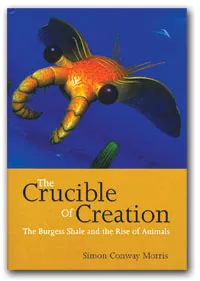
In his book, Simon Conway-Morris admits this lack of response:
If we can explain how an animal develops from the fertilized egg through a series of embryonic stages in which features such as segmentation and limbs are formed, then there is a fascinating possibility of applying this knowledge to the Cambrian explosion. Do different animals have very different sets of genetic instructions? If so, how might they have evolved, and were there special mechanisms operating in the Cambrian evolutionary burst that no longer apply today? Is it necessary to hypothesize a set of genetic instructions that were exceptionally labile, that is, unusually flexible, in order to explain the apparent plethora of animal body plans that irrupted in the Cambrian seas? We are still some way from providing definitive answers, but at the moment, and somewhat surprisingly, the answer to all these questions seems to be ‘No.151
Evolutionists’ lack of an answer to how evolutionary development could be supposedly brought about with Hox genes clearly demonstrates that this scenario is completely invalid and consists merely of blind hope. The idea that Hox genes caused the evolution and variety of Cambrian life forms is totally unscientific and completely speculative. An article titled “When Life Exploded” in Time magazine dealt with the Cambrian explosion, and clearly stated that the evolutionist claim regarding the Hox gene is a fantasy:
Of course, understanding what made the Cambrian explosion possible doesn’t address the larger question of what made it happen so fast. Here scientists delicately slide across data—thin ice, suggesting scenarios that are based on intuition rather than solid evidence [emphasis added].152
Every theory put forward regarding how Cambrian life forms emerged is an assumption, a story that evolutionists wish had actually happened. Evolutionists are perfectly aware that scientifically, there is no possibility of this actually having happened, but they refuse to abandon their claims, and when one becomes untenable, they produce another.
A powerful imagination is no challenge for evolutionists. They have invented a whole history of life on Earth, and have no qualms about making up new details within that scenario. However, no matter what they do, still there are still Cambrian life forms they cannot explain.
In one verse Allah tells us:
They plotted and Allah plotted. But Allah is the best of plotters. (Surah Al ‘Imran, 54)
Deniers are unaware of the truth revealed in this verse. Those who deny Allah, who persist in striving against Him, are unaware that they will be confronted by His plot. Since they refuse to believe that Allah has created all things, they are unable to understand that all things on the Earth and in the heavens—and everything they do themselves—is under His control.
Those who oppose Him fail to comprehend in what ways Allah’s flawless creation will appear before them. They fail to see and understand that all claims brought up in opposition to Allah are invalid right from the outset. For that reason, their efforts to keep on producing theories in opposition to the fact of creation are empty. They turn down a road where they can never obtain any results and spend their lives to that end.
Yet it is Allah Who created them as well as the Cambrian life forms of 530 million years ago, and Allah sees and knows their every deed. We are told in one verse that they will be rewarded for all these deeds in the Hereafter:
Everything in the heavens and the Earth belongs to Allah. He knows what you are engaged upon. On the Day when they are returned to Him, He will inform them of what they did. Allah has knowledge of all things. (Surat an-Nur, 64)