

Reading time: ~2 min read
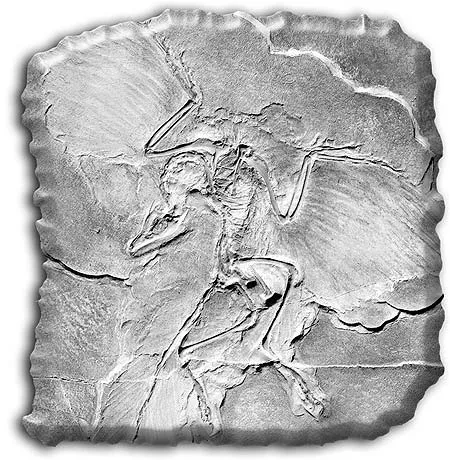
Asked why there are no semi-winged or half-winged fossils, evolutionists refer to one life form in particular: the fossil known as Archaeopteryx, the best known of the small number of supposed intermediate forms all of which are invalid, so fiercely espoused by evolutionists.
According to their thesis, Archaeopteryx, the forerunner of present-day birds, lived around 150 million years ago and was a semi-bird possessing various reptilian characteristics. This unlikely tale is repeated in just about every evolutionist publication. The fact is, however, that the latest researches into Archaeopteryx fossils have shown that the creature was very definitely not any intermediate form, merely a highly perfect structured extinct species of bird with some features slightly different from those of present-day birds.
The evidence that Archaeopteryx was a true bird and not a semi-dinosaur, semi-bird transitional form can be summarized as follows:
1. The fact that it had no sternum, or breastbone, with the same structure as that in today’s flying birds was depicted as the most important evidence that Archaeopteryx could not fly. But the seventh Archaeopteryx fossil to be discovered in 1992 provoked enormous astonishment among evolutionist circles, because it did indeed possess a sternum of the kind evolutionists had for long failed to believe in. Nature magazine said, "This attests to its strong flight muscles."244
This discovery totally invalidated the most fundamental basis for the claim that Archaeopteryx was a proto-bird lacking the full ability to fly. It has been realized that Archaeopteryx was a perfect species of bird that could fly 150 million years ago.
2. On the other hand, one of the main proofs that Archaeopteryx was genuinely capable of flight is the animal's asymmetrical feather structure, identical to that in present-day birds, showing that it was able to fly perfectly.
3. Features that evolutionists rely on when portraying Archaeopteryx as an intermediate form are the claws on its wings and the teeth in its mouth. However, these features do not demonstrate that it was connected to reptiles in any way. Two living species of birds, the Taouraco and Hoatzin, also have claws that allow them to cling to branches. Yet they are fully fledged birds, with no reptilian characteristics whatsoever. Therefore, the idea that Archaeopteryx was an intermediate form because of its clawed wings is totally invalid.
The Archaeopteryx Fossil
Nor do the teeth in Archaeopteryx's mouth make it a transitional form. In stating that its teeth are a reptilian characteristic, evolutionists are engaging in deliberate deception. Teeth are not a universal feature among reptiles. Some present-day reptiles lack teeth. The fossil record shows that there was another group that may be described as toothed birds that lived in the same period as Archaeopteryx, and even before and after it-indeed, until quite recent times.
Even more importantly, the tooth structure of Archaeopteryx and that of other toothed birds is very different from that of dinosaurs, birds' supposed evolutionary ancestors.