

Reading time: ~4 min read
Some four billion years ago, according to the evolutionist scenario, various inanimate chemical substances entered into reactions in the primitive Earth's atmosphere; these then combined with the effects of lightning and earthquakes–and thus the first living cell emerged. The fact is, however, that the structure of the cell is more complex that even the most populous and technologically advanced city. A great many systems operate non-stop with a flawless organization, from power stations that produce energy inside the cell to protein-producing factories, from a freight system that transports raw materials to decoders that translate DNA, and a dense and constant communications system.
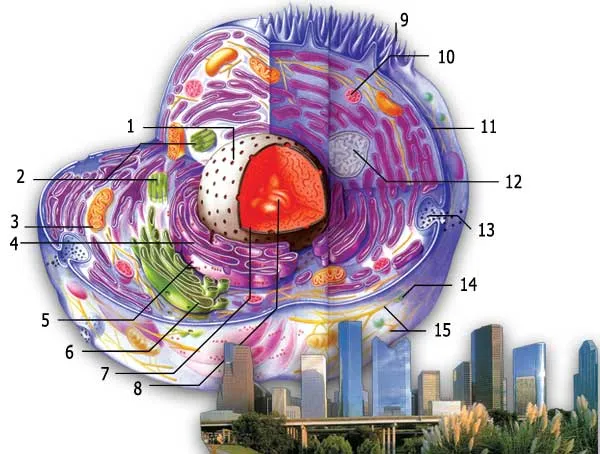
For evolutionists to believe that the cell came into being by chance is as illogical and nonsensical as claiming that all the buildings, roads, transportation systems, electricity and water networks in a city such as Istanbul, with its almost 15 million population, came into existence spontaneously as the result of such natural phenomena as storms and earthquakes.
Prof. Gerald L. Schroeder, an Israeli scientist working in the fields of physics and biology at the Massachusetts Institute of Technology (MIT) describes the order inside the cell:
The human body acts as a finely tuned machine, a magnificent metropolis in which, as its inhabitants, each of the 75 trillion cells, composed of 1027 atoms, moves in symbiotic precision. Seldom are two cells simultaneously performing the same act, yet their individual contributions combine smoothly to form life.7
Despite being an evolutionist, the late astrobiologist Carl Sagan speaks of the amazing order in the cell as if it were a work of art:
A living cell is a marvel of detailed and complex architecture. Seen through a microscope, there is an appearance of almost frantic activity. On a deeper level it is known that molecules are being synthesized at an enormous rate. Almost any enzyme catalyzes the synthesis of more than 100 other molecules per second. In ten minutes, a sizeable fraction of total mass of a metabolizing bacterial cell has been synthesized. The information content of a simple cell had been estimated as around 1012 bits, comparable to about a hundred million pages of the Encyclopedia Britannica.8
The nucleus inside the cell bears the DNA, the most important genetic material. Mitochondria inside the cell turn glucose (in the form of food products) into energy packets. Microscopic tubes extend throughout the cell, constituting vital pathways along which proteins and other required substances can be carried to the appropriate location. In addition, the billions of cells in our bodies build all their systems out of molecules, at the same time consistently maintaining and repairing themselves. As well as performing their own tasks, they also renew themselves.9 They also obtain their own energy.
Prof. Werner Gitt, director of the German Federal Institute of Physics and Technology, emphasizes how the cell is far superior to any machinery made by human beings: "The biological energy conversion system is brilliantly and cleverly designed that energy engineers can only watch, fascinated. Nobody has yet been able to copy this miniaturized and extremely efficient mechanism."10
In his book Blind Faith: Evolution Exposed, the science writer Howard Peth states that there is no such thing as a simple cell:
Formerly, it was thought that a cell was composed of nucleus and a few other parts in a "sea"' of cytoplasms, with large spaces in the cell unoccupied. Now it is known that a cell literally "swarms."' That is, it's packed full of important functioning units necessary to the life of the cell and the body containing it. The theory of evolution assumes life developed from a "simple"' cell - but science today demonstrates that there is no such thing as a simple cell.11
In conclusion, cells are not simple sacs of jelly, as was imagined in Darwin's day. On the contrary, as the 20th century physicist and astrobiologist Prof. Paul Davies puts it, they resemble computers with the most highly advanced technology, or complex cities.
References
- Gerald L. Schroeder, Tanrı'nın Saklı Yüzü, çev. Ahmet Ergenç, Gelenek Yayınları, İstanbul, 2003, ss. 58-59. ↩
- Carl Sagan, "Life" in Encyclopedia Britannica: Macropaedia, 1974, ss. 893-894. ↩
- David S. Goodsell, The Machinery of Life, Springer-Verlag, New York Inc., 1993, s. 45. ↩
- Werner Gitt, In the Beginning was Information, 3. baskı, Almanya, 2001, s. 236. ↩
- Howard Peth, Blind Faith: Evolution Exposed, Amazing Facts Inc., ABD, 1990, s. 77. ↩