

Reading time: ~5 min read
The DNA molecule is found in structures that are specially packaged in the form of chromosomes.
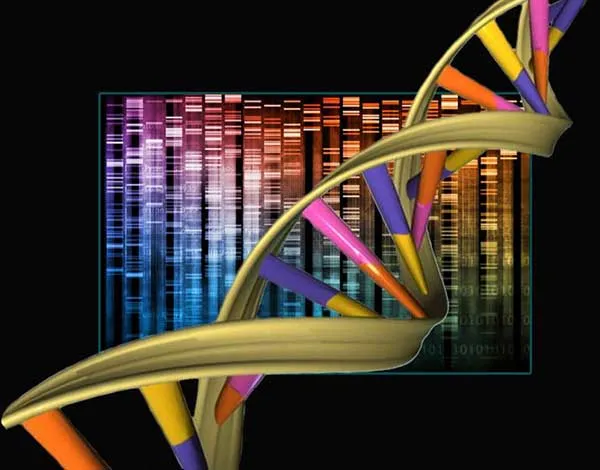
In the cell nucleus, far too small to be seen by the naked eye, are curled a total of 3 meters of DNA strings. These spiral DNA strings bound up in the chromosomes are divided up into the parts we know as "genes." Despite the tiny volume occupied by this packaging system, it possesses a huge information-storage capacity. It is calculated that there is enough information to fill around 1 million encyclopaedia pages in the nucleus of a single human cell.
Exceedingly complex systems allow this information to function. The functioning of the DNA molecule is of vital importance to a living thing's survival. Every stage of this functioning is controlled. Some stages in the functioning of the perfect system that is DNA are the following:
Encoding: Nucleotides are sequenced in the DNA string. There are four types of these; adenine, guanine, thymine and cytosine. Consecutively arranged, three-part nucleotide sequences are known as "codons." If we imagine the nucleotides as letters (A, T, C and G), then the codons are words (AAT, CAG, TCC, etc.).
Location: All the information describing all of a living thing's physical and biochemical structures is set out in the cell nucleus. However, cells in different structures will generally only require that part of the information for their own functioning. For that reason, the necessary information must be located within the huge information bank, which includes all the details of the body plan. This is done by means of enzymes: enzymes stand at specific points and open up the links which extend between the two spiral strings of the DNA, like a zipper. The points where the zipper begins and stops opening, are the borders of the relevant information. It is rather as if enzymes searched among the shelves of a giant library and took out the book they were looking for. This is a genuine miracle, because enzymes are nothing more than molecules made up of unconscious atoms.
Reading: After the required section of DNA has been found, the special enzymes attached to this section begin to read the nucleotides, three by three. The reading of these triplet nucleotide strings, in which the information is encoded, is a very particular phenomenon. The enzyme, which carries out the reading process, separates the combined millions of nucleotides into the triplets. This process takes less than one second.
Translation: There are four types of nucleotides in DNA. The proteins, which will be used in the activities and development of the organism, however, emerge from amino acids, not from the nucleotides. Living things contain 20 amino acids. In essence, the language of DNA consists of four letters, but the language of proteins consists of 20. Thus, these letters are different from one another. Yet, a surprising "translation" takes place: the enzymes, which read the codons in the DNA, "understand" that this codon refers to an amino-acid, despite the fact that there are no amino acids in the codon. The nucleotide language in the DNA is translated into the amino-acid language in the protein. Unconscious enzymes thus work yet another miracle.
Repair: Cell multiplication in the development of the body is of vital importance. During this process, the DNA in the dividing cell is copied and reproduced in the new cell. During this replication, some 3.1 billion nucleotides need to be copied in exactly the same order. If just one nucleotide in a gene is missing, then the codons in the new nucleotide order will go wrong, resulting in the synthesis of totally different proteins, which may in turn result in the death of the organism. (With the missing nucleotide, all the triple-read codons will change.) There is a system in the cells which checks and repairs these mistakes (mutations). The copied nucleotide string is checked against the original, and any errors are restored to the original form. This repair process, known as "proofreading," takes place an average of 20,000 times a second in the human body.
The complex design of these systems in DNA makes the claims of genetic transformation put forward on National Geographic TV ridiculous. Random changes in DNA—mutations, in other words—damage the sensitive genetic code in living things and give rise to abnormal organs. As shown on National Geographic, embryos exposed to poison or radiation are born totally abnormal. Mutation experiments over nearly a century have not been seen to add any information to organisms' DNA. This fact reveals the invalidity of the claim that organisms evolved from simple to complex forms by chance mutations.
Beyond these scientific facts, we can also see the truth of this from our experiences in our daily lives. Random changes in complex designs do not turn these into other complex designs. For instance, taking a chip out of a jet airplane's electronic circuits does not turn that plane into a helicopter.
In short, the complex structure of DNA represents a great obstacle to the theory of evolution. National Geographic TV's claim that DNA possesses a structure which can facilitate so-called evolution rests on Darwinist prejudices, not on the scientific facts.