

Reading time: ~4 min read

The Discovery Channel also reported errors regarding the origin of human behavior committed by Steven Pinker, a psychologist from the Massachusetts Institute of Technology, as though they were true. Pinker makes the following claims:
The actual organization of behavior goes on [at] the level of the individual nerve cells and their connections, and we have a hundred billion nerve cells, probably a hundred trillion connections. It's just mind-boggling to think of all the different ways in which they're arranged in a baby's head. And a lot of our evolution consisted not just in getting more of this stuff, but in wiring it in precise ways to support intelligence.1
As Pinker makes clear, the human brain is a most complex structure. It is even described as "the most complex thing in the universe" in scientific magazines. Furthermore, the design and processing capacity in the human brain is even used as a model by computer engineers. Dr. Kerry Bernstein, a senior technologist from the well-known company IBM, states in an interview-report called "Brain Teaches Computers a Lesson" published on MSNBC.com, that he holds regular annual conferences attended by neurologists at the IBM headquarters to inform his engineers about the design of the human brain. Bernstein says that the operations of the brain cannot be exactly copied. It operates at roughly 12 kilohertz—the equivalent of 12,000 cycles per second—and burns a fraction of the power computers do, Bernstein says. That makes it exponentially more efficient than the fastest computer, he says. "The reason is because of something that we can't do in electronics." Bernstein says. "It's this notion of massive parallelism." Meaning one bit of data can spread to 100,000 other neurons, he said.2

As well as this superior design, the brain also functions most productively. Martin S. Banks, a professor of optometry and psychology at the University of California Berkeley, says, "The brain is efficient in that it doesn't waste energy maintaining information that it will not likely need in real life."3
As we have seen, there is a phenomenal design in the arrangement and functioning of the brain. Pinker and other Darwinists, however, suggest that this order within the brain came about by chance mutations. They claim that atoms bereft of all capacity for thought established the magnificent design in the human brain solely as the result of a long "evolutionary process" based on nothing more than chance. This claim has no scientific foundation and is a violation of reason. Genetic research has shown that there is no question of mutations' adding any information to the genes, and that if they do have any effect, they are always damaging to the organism. Not one artificial mutation carried out in laboratories has ever brought any benefit to a single living thing. Embryos subjected to mutation have been seen to be born dead or crippled. It is clear that mutation could never bring about the "order" within the brain. Such a thing is as impossible as turning an electronic calculator into the most complex computer in the world by smashing it with a hammer.
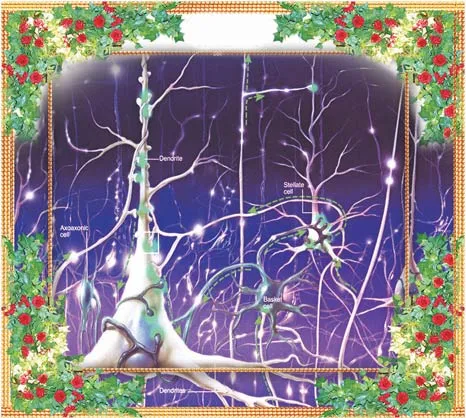
The claim that behavior is to do with nerve cells and the connections between them is also a dogma. Neuron activity concerning behavior has been detected in the brain, yet no explanation has been offered which might reduce consciousness, the source of all behavior, to the brain.
Behavior consists of the choices of action taken by man to adapt to his environment or to adapt that environment to himself. The possibility of such behavior is dependent upon his having knowledge, in other words consciousness, of his environment. Consciousness, however, is one of the major dilemmas facing materialism, since it has never proven possible to reduce consciousness to matter: no clues have ever been found as to where consciousness resides in the brain and how it emerges. The question of how consciousness comes about in man, a collection of cells, is still a mystery to materialists. Brain scan studies in the experimental field and theories put forward in the theoretical field have all failed to account for consciousness. Colin McGinn, author of the book The Problem of Consciousness, admits this failure in these words:
We have been trying for a long time to solve the mind-body problem. It has stubbornly resisted our best efforts. The mystery persists. I think the time has come to admit candidly that we cannot solve the mystery.4
All this reveals that behavior is not limited to the brain cells. Steven Pinker is actually perfectly well aware of the quandary that consciousness represents for materialism. In basing behavior on the connections between brain cells, he is attempting to cover up this dilemma facing materialism, rather than offering a consistent explanation.