

Reading time: ~6 min read
Tree bark in the mid-19th Century during the early part of the Industrial Revolution in Great Britain was light in color. For that reason, dark colored variants of the moth species (melanic moths) Biston betularia could easily be seen and caught by birds. Fifty years later, however, lichens, a kind of algae, had died out around the trees as a result of industrial pollution, and the trees had become darker in color. At this time, it was now the lighter colored moths that were more visible on the trees and that were caught more often by birds. As a result, the number of light colored moths declined, while the darker melanic moths increased in number, since these were less easily caught.
Evolutionists eagerly seized on this state of affairs as significant evidence for their claims of evolution by way of natural selection. Using the same deceptive techniques, as always, they then set about trying to mislead people into thinking that light-colored moths evolved into darker ones. This claim was heralded with the so-called phrase "evolution in action." But the facts were very different, since these moths in fact underwent no evolutionary change at all, the only thing present being a huge Darwinist deception.
In 1953, H.B.D. Kettlewell, a Darwinist doctor of medicine and also an amateur biologist, decided to perform an experiment to observe the phenomenon. He carried out experiments and observations in rural parts of England where these moths were living. As a result of his experiments, Kettlewell determined that dark moths on lighter lichen were caught in larger numbers. He then announced this in an article titled "Darwin's Missing Evidence" in Scientific American magazine, as if this were a giant discovery in the name of Darwinism. By 1960, Kettlewell's account had assumed its place in all school text books.
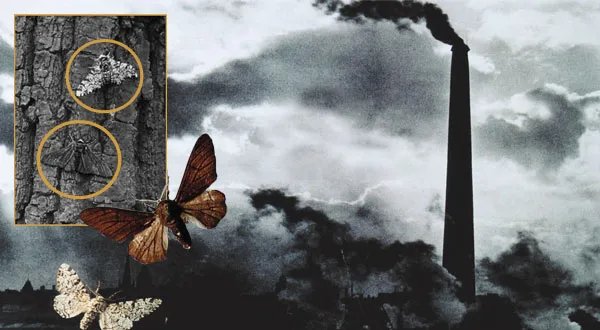
In 1985, certain peculiarities began to be noticed. A young American biology teacher called Craig Holdrege came across an interesting statement in the notes of Sir Cyril Clarke, a close friend of Kettlewell and who took part in his experiments. Clarke said:
All we have observed is where the moths do not spend the day. In 25 years, we have only found two betularia on the tree trunks or walls adjacent to our traps...89
Holdrege had for a long time been showing his students photographs of moths placed on tree trunks and describing how birds would locate and catch the more visible ones. But now someone who had researched these moths for 25 years was saying he had only seen moths on the tree trunks twice. A fierce scientific debate erupted almost immediately. The debate led to the following conclusions: many studies performed after Kettlewell's experiments showed that the moths landed on only one kind of tree trunk, preferring the undersides of horizontal branches of all other kinds of tree. Since the 1980s, everyone has been in agreement that moths land only very, very rarely on tree trunks. Many scientists, such as Cyril Clarke and Rory Howlett, who conducted a 25-year study on the subject, as well as Michael Majerus, Tony Liebert and Paul Brakefield have declared that "Kettlewell obliged the moths to behave in an unnatural manner in his experiments, for which reason the results of the experiment are scientifically unacceptable."
Researchers investigating Kettlewell's experiment encountered an even more astonishing finding; while there should have been more light-colored moths in unpolluted regions of England there were actually four times as many dark ones. In other words, contrary to what Kettlewell claimed, and what had been reiterated in every evolutionist reference book, there was no correlation between tree bark and the ratios in the moth population.
The American lepidopterist (an expert engaged in scientific study of butterflies and moths) Ted Sargent and other researchers noted that the moths in question did not land on the tree trunks but hid beneath the upper branches. In addition, the moths slept in the day and flew about at night; in other words, when the birds were asleep!90
The more the matter was investigated, the greater the scale of the scandal: the "moths on tree bark" photographed by Kettlewell were actually dead. Since moths settle on the under sides of the branches rather than on the tree trunk, there was effectively no means of obtaining such an image. For that reason, Kettlewell stuck these dead animals to the trees with glue and then photographed them.91
The New York Times made this comment when it was realized that the moths that Darwinists had so loudly portrayed as scientific evidence for around a century were in fact fraudulent: "The most famous example of evolution in action must now become the most infamous"92
When The University of Chicago evolutionary biologist learned about this fraud in 1998, he wrote of his "shame" due to the Industrial Revolution moths he had been teaching his students about for years being a hoax, and compared his reaction to "the dismay attending my discovery, at age 6, that it was my father and not Santa who brought the presents on Christmas Eve."93
With the revelation of all these facts, people realized that the tale of the Industrial revolution moths, depicted as "Darwin's missing evidence," was in fact a giant deception. For decades hundreds of millions of people had been deceived by photographs of a few dead moths glued onto a tree and a hoary old tale concerning them. The real truth of the matter is this: the evidence that Darwin needed does not exist and it is impossible for it ever to be found. Because living things did not evolve.
The interesting thing is that the Industrial Revolution moths are still presented in some text books as evidence of evolution. In this way, Darwinists aim to mislead impressionable young minds that are unaware of this fraud. Depicting a fraud as genuine evidence, even though this fraud has already been exposed, is in fact evidence of Darwinism's despair, lack of proof and purely ideological nature. The fact of Creation is clear to see. Darwinists trying to avoid this clear fact imagine they can find a solution by resorting to lies and trickery. But Allah will certainly do away with trickery and falsehood and superstitious religions.
References
- Judith Hooper, Of Moths and Men, W.W. Norton & Company, Inc., New York, 2002, s.xvii ↩
- Ann Coulter, Godless: The Church of Liberalism, Crown Forum Publishing, 2006, s. 236-237 ↩
- Judith Hooper, Of Moths and Men, s. xviii ↩
- Ann Coulter, Godless: The Church of Liberalism, Crown Forum Publishing, 2006, s. 237 ↩