

Reading time: ~4 min read
The propaganda tactic so often resorted to in documentaries on National Geographic TV consists of showing examples of intelligent behavior by apes and then drawing comparisons between them and human beings. This tactic can be seen in expressions like "they are intelligent animals," "their needs closely resemble those of human beings," and "like us, they feel the need for personal bonds and interpersonal relationships."
The commentary in My Favorite Monkey mentions that apes produce creative solutions in the face of problems in nature and that they are intelligent problem-solvers. It says the line between human and ape behavior may be very unclear.
In another narration, it is stated that they resemble us physically; we use them in space and medical research. Also, they resemble us socially, but we keep that to ourselves. Family life is very important among members of the macaque species and we are so closely related that …

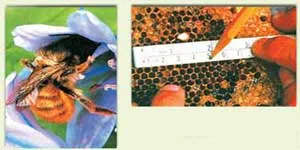
Yet the inconsistency of constructing an evolutionary link between man and ape in respect of intelligence and interpersonal relationships is quite evident. There are other animals far superior to apes when it comes to intelligence and relationships. Bees, for instance, are able to employ the kind of architecture in building their combs that only a mathematician's calculations could match.3 A geometrical plan can be seen in the comb, one that allows the least possible material to be used in the construction but the greatest possible amount of area for storage. (In the identification of such an "optimal" design the area and circumferences of different geometrical shapes need to be calculated, and the geometric shape with the highest area/circumference ratio should be selected.)
In the same way, beavers are able to build their nests against the current in the middle of rivers, employing the kind of engineering abilities used by man in constructing dams.4 Termites build magnificent towers capable of comparison with our own skyscrapers, and set up air-conditioning systems, special storage chambers and agricultural areas inside them. The fact, of course, that they display a visibly sensitive mathematical and geometrical knowledge in their buildings and use engineering techniques does not imply that we are related to bees, beavers, or termites.
Neither is the fact that monkeys feel the need for interpersonal bonds and relationships evidence for evolution. Creatures that have no possible relation to human beings also enjoy similar bonds and relationships. Penguins, for example, raise families full of love and loyalty. Dogs are much more faithful and friendly in the relationships they establish with human beings. Doves enjoy close relations with their mates. Budgerigars exhibit enormous interest and devotion to one another, and also to human beings. Yet these features do not make penguins, doves, budgerigars, and dogs our relatives.
On the other hand, these animals do reveal the invalidity of the theory of evolution's claims regarding the origin of their intelligence and behavior. Despite the fact that the creatures we have just listed are located on branches of the imaginary evolutionary tree far more distant from man than are chimpanzees, they are still able to display behavior much closer to human intelligence than that of chimpanzees.
Honeybees reveal yet another contradiction which the theory of evolution is quite incapable of accounting for. The theory seeks to account for level of intelligence by the development of the nervous system. For instance, it links the fact that man is the most highly developed living thing to his having the highest brain/body ratio. According to this logic, chimpanzees, with a much more complex nervous system than that of bees, should be far superior to them. Yet the truth is actually the exact opposite. The fact that a creature much further away from man on the imaginary evolutionary tree than the chimpanzee is able to display the kind of complex behavior seen in man, despite its being a simple organism, – the way it calculates the surface area and circumference of the hexagon and measures internal angles, for instance – definitively invalidates the evolutionist claims with regard to ape intelligence.